

⚡ BREAKING NEWS
Swalwell Faces New Allegations Over Nanny's Immigration Status Appeals Court Allows Trump Administration Access to Social Security Data US Arrests Iranian Nationals Linked to Regime Officials FBI Documents Reveal Pre-Jan. 6 Violence Warnings <p><strong>Fairside News is evolving.</strong> As we approach our one-year anniversary, we’re expanding into real-time breaking news powered by global RSS feeds, while enhancing our platform with richer visuals—now featured in nearly 80% of articles—and improved AI-driven workflows.</p> <p>What began as timely reporting has grown into a faster, more dynamic news source, with readership approaching 700,000 article views. Stay informed with clear, fact-based coverage and perspectives from both sides of the aisle.</p>
Sponsor Advertisement
Kamala Harris Hints at Potential 2028 Presidential Bid
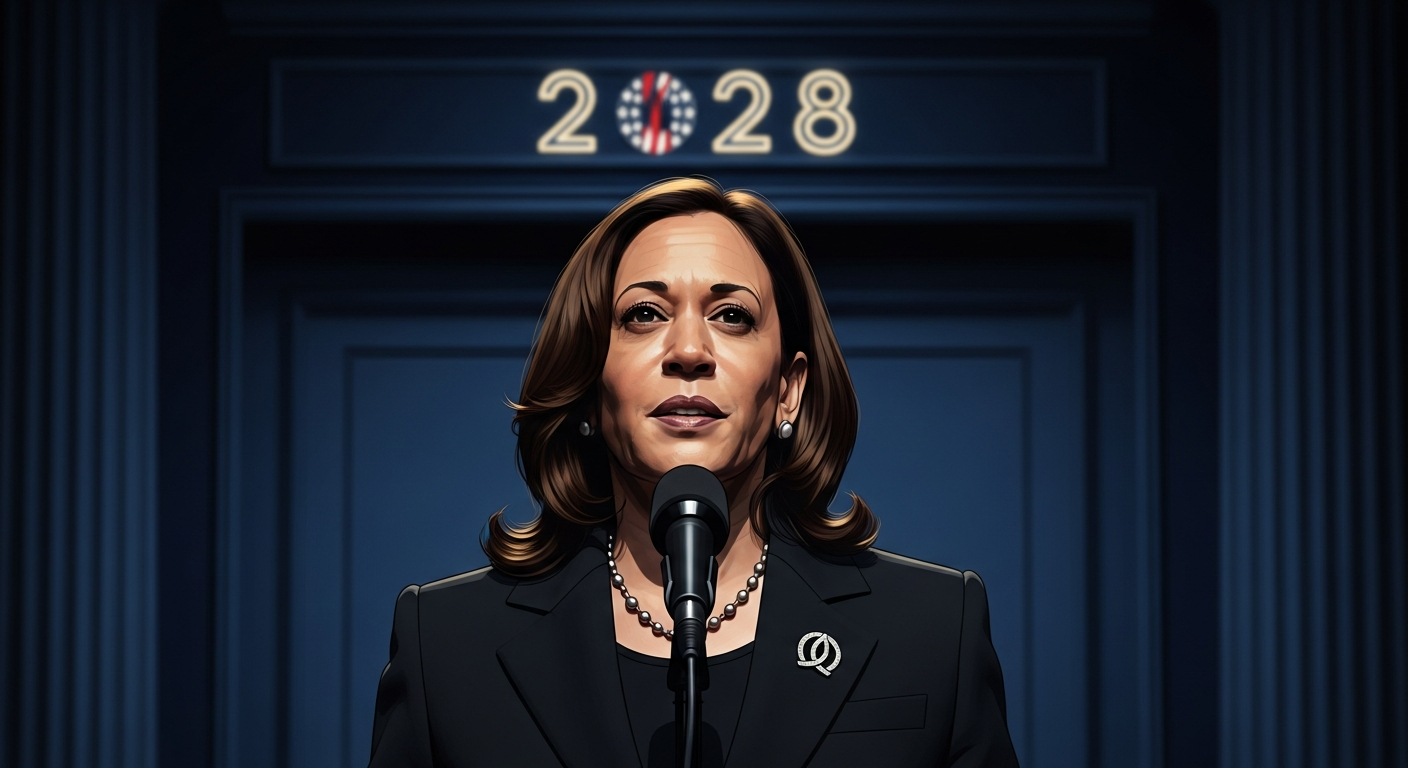
AI-generated image for: Kamala Harris Hints at Potential 2028 Presidential Bid

Kamala Harris Hints at Potential 2028 Presidential Bid

Kamala Harris indicated she is considering a run for president in 2028 during an interview at the National Action Network convention. Her remarks included sharp criticism of President Donald Trump's economic and foreign policies.

Kamala Harris signaled a potential return to national politics, telling supporters in New York City on April 10, 2026, that she is contemplating another run for the White House in 2028. The comments were made during an on-stage interview with Rev. Al Sharpton at the National Action Network convention, drawing significant attention from attendees and political observers.

"I might. I’m thinking about it." — Kamala Harris, Former Vice President.

When directly asked about her plans for a future presidential campaign, Harris stated, "I might. I’m thinking about it." This response was met with loud applause from the audience, with shouts of "run again" echoing through the venue. Harris, while smiling, did not offer a firm commitment, adding, "I’ll keep you posted." Her remarks represent one of the clearest indications yet that she is weighing a second bid for the presidency, following her loss to President Donald Trump in the 2024 election.

The 2024 election saw Harris fail to secure a single battleground state, a result that significantly impacted her standing within the Democratic Party. Despite this electoral setback, her appearance at the convention served to reinsert her into the national political discourse, positioning her as a potential contender in the Democratic primary field for 2028.

Throughout her interview, Harris launched sharp critiques against President Donald Trump, focusing particularly on economic issues. She accused President Trump of misleading voters regarding his ability to lower prices and improve affordability for average Americans. "He lied," Harris asserted, arguing that President Trump had instead prioritized the interests of wealthy allies and his own family. She further claimed, "He is telling the American people he doesn’t care about you," escalating her rhetoric against the sitting president.

Beyond economic policy, Harris also extended her criticism to Republicans in Congress, labeling them as "cronies" and alleging that their actions were driven by self-interest rather than the needs of their constituents. These remarks align with what appears to be a broader Democratic strategy aimed at the upcoming midterm elections, with Harris encouraging the audience to vote and emphasizing the importance of these races as Democrats seek to regain control of Congress. The New York Post reported on these aspects of her address.

Foreign policy also featured prominently in Harris's critique of President Trump's administration. She specifically targeted his handling of Iran, accusing him of exaggerating military successes and misrepresenting the status of Iran’s nuclear capabilities. Harris quoted President Trump's past statements, saying, "Obliterated it… which is not an ambiguous term," to underscore her contention that his claims were inaccurate. She further argued that President Trump’s foreign policy decisions have jeopardized U.S. service members and strained relationships with key international allies. "We have become more unreliable under this man," Harris stated, warning that the process of repairing these alliances could take several years.

The National Action Network convention also hosted other prominent Democratic figures, including governors and national personalities, who are reportedly exploring their own ambitions for the 2028 presidential race. However, Harris appeared to be the primary draw, eliciting the strongest reaction from the attending crowd. Her presence and candid remarks underscore the nascent stages of what is expected to be a competitive Democratic primary cycle. Simultaneously, President Trump is anticipated to wield considerable influence in shaping the Republican field, even if he is not on the ballot himself.

Harris's re-emergence into the public eye and her willingness to directly challenge President Trump's policies suggest a deliberate effort to rebuild her political profile and test the waters for future electoral endeavors. Her strategy appears to involve drawing clear distinctions between her policy vision and that of the current administration, particularly on economic and foreign policy fronts, as the Democratic Party begins to consider its future leadership.

Advertisement

The Flipside: Different Perspectives

Progressive View

From a progressive viewpoint, Kamala Harris's potential 2028 presidential bid and her sharp criticisms of President Trump resonate deeply with concerns about social justice, economic equity, and collective well-being. Her assertion that President Trump "lied" about his ability to lower prices and that "He is telling the American people he doesn’t care about you" speaks to a core progressive belief that the current economic system disproportionately benefits the wealthy at the expense of average citizens. Progressives would argue that systemic issues, such as wealth inequality and corporate influence, require robust government intervention and policies designed to uplift all members of society, rather than relying solely on market forces. This includes advocating for policies that ensure affordable healthcare, education, and housing, and addressing the root causes of economic insecurity.

Harris's critique of "cronies" in Congress and her emphasis on the importance of midterm elections align with the progressive call for greater accountability from elected officials and the need to elect representatives committed to serving the public interest over special interests. On foreign policy, her concerns about the U.S. becoming "more unreliable" and the impact on alliances reflect a progressive commitment to multilateralism, diplomacy, and human rights as foundational elements of global stability. Progressives believe that strong international cooperation is essential to address shared challenges like climate change and global health, and that a stable, predictable foreign policy is crucial for America's standing and security. Her re-emergence is seen as a vital voice for these values and a necessary counterpoint to conservative governance.

Conservative View

From a conservative perspective, Kamala Harris's signaling of a potential 2028 presidential run, coupled with her criticisms of President Trump, can be viewed through the lens of political opportunism rather than substantive policy debate. Her remarks accusing President Trump of lying about economic issues and prioritizing wealthy allies might be dismissed as typical partisan rhetoric, especially given her own past electoral performance. Conservatives often advocate for free-market principles, arguing that government intervention, such as price controls or increased regulation, often distorts markets and hinders economic growth. They would likely contend that President Trump's policies, focused on deregulation and tax cuts, aimed to stimulate the economy by fostering individual liberty and entrepreneurship, ultimately benefiting all Americans through job creation and investment.

Regarding foreign policy, the conservative viewpoint often prioritizes a strong national defense and decisive action to protect U.S. interests. Criticisms of President Trump's handling of Iran or alliances might be seen as undermining efforts to project strength and secure America's position on the global stage. Conservatives would argue that President Trump’s approach sought to reset alliances based on mutual benefit and hold adversaries accountable, rather than being "unreliable." The emphasis on personal responsibility suggests that individuals and states should primarily address their own economic challenges, rather than relying on broad governmental programs that Harris might advocate. Her re-entry into the political conversation is seen as a move to rally the Democratic base, rather than offering a new vision that transcends partisan lines.

Common Ground

Despite differing approaches, conservatives and progressives can find common ground on several key areas highlighted by Kamala Harris's recent statements. Both sides generally agree on the importance of a strong and stable economy, even if they disagree on the best methods to achieve it. The desire for lower prices and improved affordability for American families is a shared goal, as is ensuring that the economic system provides opportunities for all. While conservatives may emphasize individual enterprise and progressives may focus on systemic support, both ultimately seek a prosperous society where citizens can thrive.

Furthermore, both viewpoints typically value national security and a foreign policy that protects American interests. While the strategies for engaging with allies and adversaries may differ, the fundamental objective of maintaining U.S. influence and safeguarding service members is shared. There is also a mutual understanding of the importance of democratic participation and accountability in government. Both conservatives and progressives would agree that elected officials should serve the public interest and that robust political debate, including through elections, is essential for a healthy democracy. Encouraging voter engagement and ensuring transparent governance are bipartisan ideals that transcend specific policy disagreements, providing a foundation for constructive dialogue on the future direction of the country.