

⚡ BREAKING NEWS
Swalwell Faces New Allegations Over Nanny's Immigration Status Appeals Court Allows Trump Administration Access to Social Security Data US Arrests Iranian Nationals Linked to Regime Officials FBI Documents Reveal Pre-Jan. 6 Violence Warnings <p><strong>Fairside News is evolving.</strong> As we approach our one-year anniversary, we’re expanding into real-time breaking news powered by global RSS feeds, while enhancing our platform with richer visuals—now featured in nearly 80% of articles—and improved AI-driven workflows.</p> <p>What began as timely reporting has grown into a faster, more dynamic news source, with readership approaching 700,000 article views. Stay informed with clear, fact-based coverage and perspectives from both sides of the aisle.</p>
Sponsor Advertisement
Appeals Court Allows White House Ballroom Construction to Continue
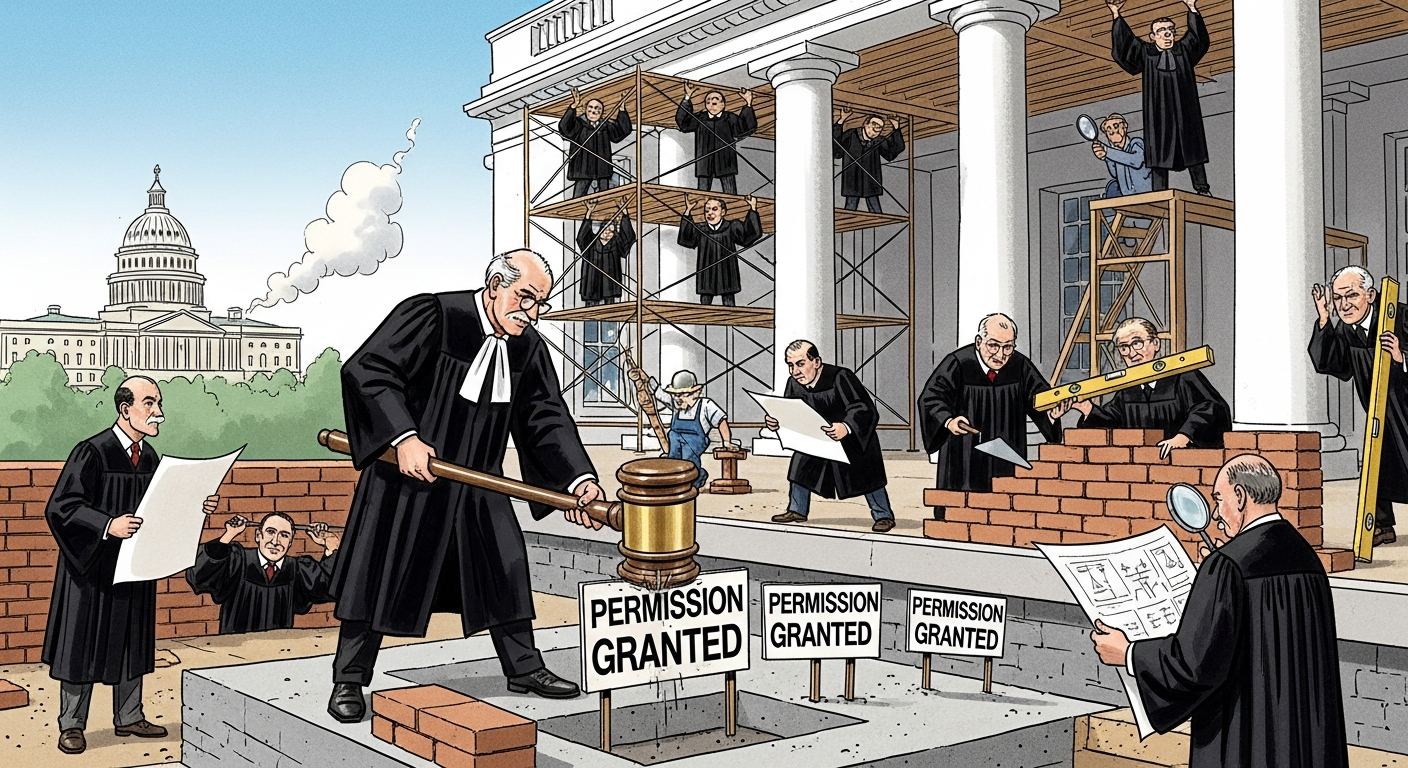
AI-generated image for: Appeals Court Allows White House Ballroom Construction to Continue

Appeals Court Allows White House Ballroom Construction to Continue

A federal appeals court has temporarily permitted construction of a new White House ballroom to proceed, overturning a lower court's halt order. The court referred the core dispute over presidential authority back for further review, citing unclear safety and security necessities.

A federal appeals court has recently allowed construction of a new White House ballroom to continue, temporarily overriding a lower court's injunction that had halted most work on the project. The decision by the U.S. Court of Appeals for the D.C. Circuit permits the construction to move forward for at least another week as judges conduct further review of the complex legal and constitutional questions at play.

The central issue in the dispute revolves around whether President Donald Trump possesses the authority to undertake such a significant structural addition to the White House without direct congressional approval. While the appeals court's ruling did not definitively resolve this fundamental question, it sent the case back to the lower court for more detailed analysis. The judges stated in their order that "it remains unclear" how much of the ongoing construction is genuinely necessary for safety and security purposes, a factor that contributed to their decision to allow work to proceed temporarily.

The project itself is substantial in scope, envisioning an approximately 89,000-square-foot ballroom. If completed, this addition would be larger than the main White House residence. Construction commenced following the demolition of the East Wing last year, an action that immediately drew criticism and legal challenges from preservation groups.

The National Trust for Historic Preservation initiated a lawsuit to challenge the legality of the project. The organization contends that an undertaking of this magnitude, which involves major structural alterations to a historic landmark, necessitates explicit congressional approval and should not advance without appropriate oversight. A federal district judge initially sided with the preservation group, issuing a sharply worded ruling that stated President Trump was proceeding unlawfully and ordering a halt to most construction, with limited exceptions for work directly related to safety. The district judge underscored the limits of executive authority by stating, "The President… is not the owner."

President Trump and his legal team swiftly contested the lower court's ruling. They argued that the project incorporates critical national security upgrades that cannot be delayed without compromising the safety of the President and other personnel within the White House. According to court filings submitted by the administration, the construction plans include advanced features such as missile-resistant materials, reinforced structural elements, and sophisticated security systems. Officials have asserted that these enhancements are indispensable for protecting the occupants of the White House.

The appeals court did not fully endorse the administration's national security argument but indicated that it warranted closer examination. This temporary allowance provides the administration a narrow window to continue construction activities while the legal process unfolds.

The ruling from the D.C. Circuit Court of Appeals was not unanimous, reflecting the deep divisions over the legal and constitutional interpretations involved. Two of the judges supported the decision to remand the case for further review and allow temporary construction, while a third judge dissented. This internal judicial disagreement highlights the complexity and contentious nature of the legal battle.

The case has emerged as a significant flashpoint in the broader debate concerning the scope of presidential authority. Critics of the project argue that it bypasses established oversight mechanisms and risks irrevocably altering a treasured historic landmark without the necessary legislative consent. Conversely, supporters maintain that the President has an inherent responsibility to modernize and enhance the security of the White House to meet contemporary threats. The construction of a permanent event space has been a long-standing objective for President Trump, who has advocated for such a facility to replace the temporary structures historically used for major White House functions. The ongoing legal proceedings will continue to scrutinize the balance between executive prerogative, legislative oversight, and historic preservation.

Advertisement

The Flipside: Different Perspectives

Progressive View

Progressives view the ongoing legal dispute over the White House ballroom construction as a critical test of checks and balances and the importance of democratic oversight. The initial ruling by the federal district judge, which questioned presidential authority and ordered a halt, resonates with the progressive emphasis on limiting executive power and ensuring accountability. The argument by the National Trust for Historic Preservation, advocating for congressional approval for major structural changes to a national landmark, aligns with the progressive commitment to preserving public heritage and ensuring that significant decisions are made transparently and with broad consensus, not solely by executive decree. Concerns arise about the potential for President Trump to bypass established procedures and alter a historic public asset without proper legislative and public input. This situation highlights the progressive belief that collective well-being, which includes safeguarding national heritage and democratic processes, should take precedence over unilateral executive action. The non-unanimous appeals court ruling further underscores the validity of these concerns and the need for rigorous scrutiny of presidential actions that could set precedents for future executive overreach.

Conservative View

From a conservative perspective, the appeals court's decision to allow White House ballroom construction to continue, even temporarily, underscores the executive branch's inherent authority to manage and secure federal property, particularly the residence of the President. The administration's argument that the project involves "critical national security upgrades" aligns with the principle of a strong executive capable of protecting national assets and personnel. Conservatives typically emphasize that the President, as Commander-in-Chief and head of state, has a non-negotiable duty to ensure the safety and operational effectiveness of the White House. Interfering with such projects through judicial overreach or protracted congressional approval processes could be seen as undermining the President's ability to govern effectively and respond to evolving security threats. Furthermore, the notion of a President needing explicit congressional approval for every structural modification to the White House could set a precedent that unduly burdens future administrations and limits executive flexibility in maintaining essential infrastructure. The focus remains on the President's responsibility to act decisively in the interest of national security and efficient governance, viewing the project as a necessary modernization rather than an arbitrary alteration.

Common Ground

Despite differing viewpoints, both conservative and progressive perspectives can find common ground on the fundamental importance of White House security. There is a shared understanding that the President and those who work within the White House require a secure environment, and that national security considerations are paramount. Both sides can also agree on the need for clear, well-defined processes for major construction projects involving federal landmarks. While they may disagree on who holds ultimate authority, there is likely consensus that ambiguity in legal frameworks can lead to costly and time-consuming disputes. A bipartisan effort to establish clearer guidelines for executive branch renovations, balancing security needs with historic preservation and congressional oversight, could prevent similar conflicts in the future. Furthermore, both sides value the White House as a symbol of American democracy and history, even if they differ on the methods of its preservation and modernization.