

⚡ BREAKING NEWS
Swalwell Faces New Allegations Over Nanny's Immigration Status Appeals Court Allows Trump Administration Access to Social Security Data US Arrests Iranian Nationals Linked to Regime Officials FBI Documents Reveal Pre-Jan. 6 Violence Warnings <p><strong>Fairside News is evolving.</strong> As we approach our one-year anniversary, we’re expanding into real-time breaking news powered by global RSS feeds, while enhancing our platform with richer visuals—now featured in nearly 80% of articles—and improved AI-driven workflows.</p> <p>What began as timely reporting has grown into a faster, more dynamic news source, with readership approaching 700,000 article views. Stay informed with clear, fact-based coverage and perspectives from both sides of the aisle.</p>
Sponsor Advertisement
Harris's Trump Imitation Draws Scrutiny at NYC Event
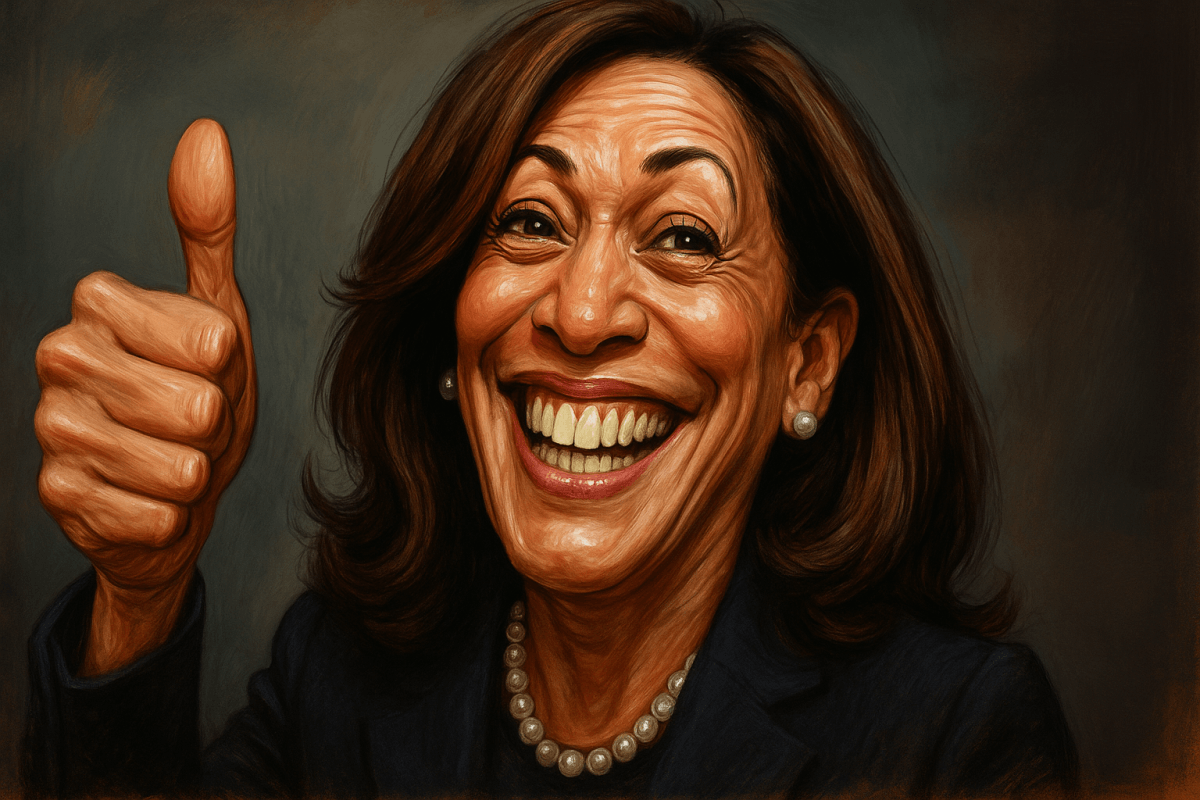
AI-generated image for: Harris's Trump Imitation Draws Scrutiny at NYC Event

Harris's Trump Imitation Draws Scrutiny at NYC Event

Kamala Harris faced criticism after imitating President Trump during a New York event, using a voice described by critics as a "mob boss" accent. The remarks, made during a discussion on foreign policy, quickly circulated online, drawing varied reactions.

Kamala Harris adopted a stylized accent during a public appearance in New York on April 10, 2026, while characterizing President Donald Trump's approach to international relations, drawing immediate criticism. The remarks occurred during a sit-down conversation with Reverend Al Sharpton at the National Action Network event, where Harris discussed foreign policy, global alliances, and her potential 2028 presidential ambitions.

"What he is doing is making us weaker, unreliable, and less influential." — Kamala Harris

During the discussion, Harris attempted to portray what she described as President Trump's mindset regarding negotiations with foreign leaders. She stated, "He’s kind of like… ‘you take Eastern Europe and I’ll take the Western Hemisphere,’" using a voice that critics later widely described online as a "mob boss" impression. The moment was quickly shared across social media platforms, becoming a central point of public reaction to her appearance.

The imitation prompted varied responses from commentators and social media users. Many critics mocked the delivery, labeling it "awkward," "ineffective," and "cringey." Some argued that the impression detracted significantly from any substantive policy arguments Harris was attempting to convey. This incident also led several commentators to recall past criticisms directed at Harris regarding her speaking style, specifically accusations of adjusting her tone or cadence depending on the audience. The circulation of this latest clip reignited concerns among some about her perceived authenticity in public address.

Despite the immediate backlash surrounding her delivery, Harris continued to articulate her broader critique of President Trump’s foreign policy framework, often referred to as "America First." She contended that this approach has adversely affected the United States' standing on the global stage by creating strain in relationships with traditional allies and reducing overall diplomatic engagement. Harris asserted, "What he is doing is making us weaker, unreliable, and less influential." She further warned that a withdrawal from established international partnerships could create strategic voids, potentially allowing adversaries, particularly China, to expand their influence in key geopolitical regions. In contrast, Harris highlighted her own previous work in the Indo-Pacific, citing it as an example of efforts aimed at countering such influence and strengthening alliances.

The National Action Network gathering was part of a broader series of public engagements for Harris, signaling her reemergence into national political discourse as she considers a possible return to the presidential race in 2028. In recent weeks, she has indicated an openness to a future presidential run, telling various audiences she is "thinking about it" while refraining from making any formal announcement. Events such as this provide Harris with a platform to reintroduce herself to voters, articulate her policy positions, and gauge public reception ahead of a potential campaign.

However, the significant public reaction to her accent imitation underscores the challenges public figures, especially those contemplating high-profile political bids, face in controlling the narrative surrounding their appearances. For many, the focus of public attention shifted away from her detailed policy arguments and towards the delivery and tone of her remarks. Supporters of Harris have largely argued that the criticism is disproportionate and distracts from the substantive policy message she intended to deliver. Conversely, critics maintain that such moments undermine her credibility and make it more difficult for her to present herself as a serious and viable contender for future national leadership. The incident highlights the intense scrutiny political communication receives in the current media landscape.

Advertisement

The Flipside: Different Perspectives

Progressive View

Progressives might view Kamala Harris's imitation as a rhetorical device intended to effectively highlight what they perceive as problematic aspects of President Trump's "America First" foreign policy. From this perspective, the accent was an attempt to underscore the transactional and potentially isolationist nature of his approach to international relations, which progressives often argue undermines global cooperation and the United States' moral authority. The subsequent criticism, they might contend, is largely a distraction from Harris's substantive warnings about weakened alliances and expanding adversarial influence, particularly from China. Progressives often emphasize the importance of calling out perceived systemic flaws in policy, and creative communication can be seen as a legitimate tool to draw attention to these concerns. They might argue that focusing on the delivery rather than the message serves to discredit a prominent figure and deflect from a necessary debate about the future of U.S. foreign policy. The criticism could be seen as an attempt to silence dissenting voices or to enforce a rigid, often unhelpful, standard of political communication.

Conservative View

From a conservative perspective, Kamala Harris's use of a "mob boss" accent to characterize President Trump's foreign policy reflects a concerning lack of seriousness and authenticity in political discourse. Conservatives often prioritize a grounded, professional approach to discussing complex issues like international relations. Such theatrical imitations are seen as a distraction from substantive policy debate, potentially trivializing critical matters of national security and global diplomacy. This type of communication can be viewed as an attempt to score political points through caricature rather than engaging with the merits of an argument. It raises questions about a candidate's judgment and their ability to command respect on the world stage, suggesting a superficial understanding of foreign policy. Emphasizing individual responsibility for one's public presentation, conservatives might argue that candidates should focus on clearly articulating their vision and policy proposals, allowing voters to assess their leadership capabilities based on substance, not performance. The incident reinforces concerns about a pattern of shifting rhetorical styles, which can be interpreted as a lack of a consistent, genuine political identity.

Common Ground

Despite differing interpretations of Kamala Harris's recent remarks, there are areas of common ground regarding political communication and foreign policy. Both conservatives and progressives generally agree on the importance of a strong and effective U.S. foreign policy that protects national interests and promotes stability. There is also a shared understanding that public figures, particularly those aspiring to high office, are subject to intense scrutiny regarding their communication style and policy positions. Both sides value clarity and substance in political discourse, even if they disagree on what constitutes effective communication or how best to convey complex ideas. Furthermore, there is a bipartisan interest in ensuring that political debates contribute constructively to public understanding rather than devolving into mere spectacle. All stakeholders can agree that the ability of a leader to effectively communicate with both domestic and international audiences is crucial for national leadership.