


⚡ BREAKING NEWS
● BREAKING Accused Charlotte Killer Ruled Mentally Incompetent for Trial Gilgo Beach Suspect Pleads Guilty to Eight Murders Fuller Wins Georgia Special Election, Boosts GOP Majority American Journalist Freed in Iraq After Week-Long Captivity <p><strong>Fairside News is evolving.</strong> As we approach our one-year anniversary, we’re expanding into real-time breaking news powered by global RSS feeds, while enhancing our platform with richer visuals—now featured in nearly 80% of articles—and improved AI-driven workflows.</p> <p>What began as timely reporting has grown into a faster, more dynamic news source, with readership approaching 700,000 article views. Stay informed with clear, fact-based coverage and perspectives from both sides of the aisle.</p>
Sponsor Advertisement
UVU Commencement Speaker Sparks Controversy After Kirk's Death
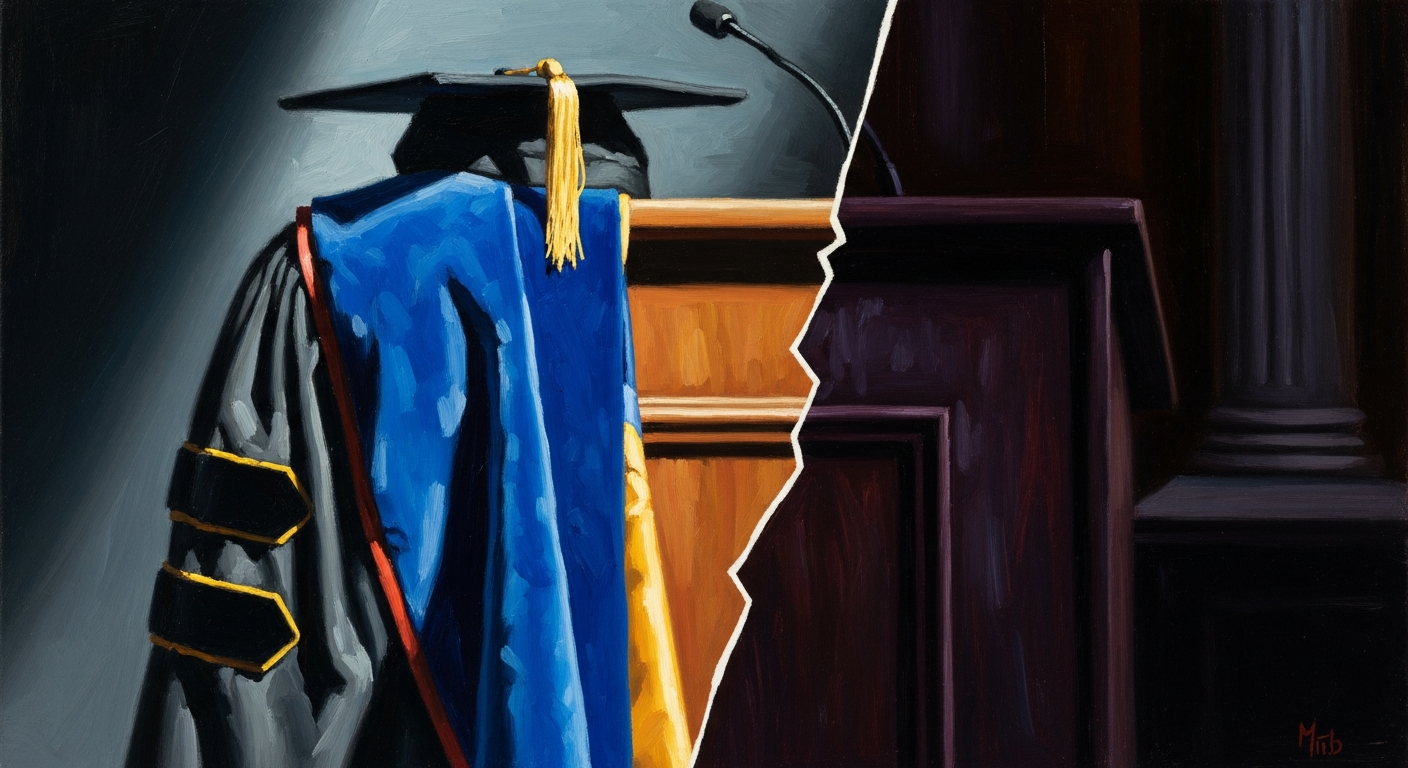
AI-generated image for: UVU Commencement Speaker Sparks Controversy After Kirk's Death

UVU Commencement Speaker Sparks Controversy After Kirk's Death

Utah Valley University announced Sharon McMahon as its 2026 commencement speaker, drawing criticism from Turning Point USA's UVU chapter regarding McMahon's social media posts about the assassination of conservative figure Charlie Kirk.

Utah Valley University (UVU) has selected Sharon McMahon, a social media personality known for her civics-focused content, as its 2026 commencement speaker, an announcement made on March 26. This decision has generated significant controversy, particularly from the university's Turning Point USA (TPUSA) chapter, stemming from McMahon's social media activity following the assassination of Charlie Kirk, the founder of Turning Point USA.

"While universities should welcome diverse viewpoints, platforming someone who treated a historic and tragic political assassination, not as a moment to grieve, but as an opportunity to create content, is tone-deaf and disrespectful to those still affected, especially on this campus." — Caleb Chilcutt, President, Turning Point USA at UVU

Charlie Kirk, a prominent conservative voice and founder of Turning Point USA, was shot and killed in September of last year. Tyler Robinson stands accused of the murder and is currently undergoing capital punishment proceedings in a Utah court. Just two days after Kirk's death, McMahon posted content on Instagram and Threads that challenged Kirk's legacy, an action that has been a focal point of the current dispute.

UVU's announcement highlighted McMahon as a "principled educator" dedicated to "breaking down topics in civics, history, and current events with nonpartisan explanations to help empower informed discussions." However, the TPUSA chapter at UVU and others have questioned this characterization in light of McMahon's past remarks concerning Kirk.

On September 12, McMahon shared a collection of Kirk's quotes on Instagram and Threads, accompanying them with text that framed him as a figure who disseminated "bigoted ideas" to millions. While the Instagram post has since been deleted, the Threads version remains accessible. In her Threads caption, McMahon stated, "These aren’t sound bites taken out of context. Millions of people feel they were harmed, and the murder that was horrific and should never have happened does not magically erase what was said or done."

One specific quote highlighted by McMahon originated from a Kirk podcast appearance, where he said, "If I see a black pilot, I’m going to be like, ‘Boy I hope he’s qualified.'" McMahon presented this as evidence of Kirk's worldview, writing that it "casts suspicion on all black professionals, not just individuals, and sounds like he automatically views black Americans as less intelligent or less educated."

However, critics, including the TPUSA chapter, contend that McMahon omitted crucial context from Kirk's remarks. Immediately following the highlighted sentence, Kirk stated, "That’s not who I am, that’s not what I believe." He then elaborated on his argument, attributing such "unhealthy thinking patterns" to diversity quota mandates from airline executives. Kirk explained his concern was that these policies could lead to a scenario where "a white qualified guy is not gonna get the job," fostering public doubt. He described this impulse as something "no one should" experience, blaming it squarely on Diversity, Equity, and Inclusion (DEI) policies.

Caleb Chilcutt, who serves as the president of the Turning Point USA chapter at UVU, expressed strong disapproval of the university's choice. In a statement, Chilcutt told The Post Millennial, "Sharon McMahon posted a now-deleted series of out-of-context quotes from Charlie in an effort to tarnish his name and minimize the tragedy, rather than offering condolences or condemning political violence." He characterized the university's decision as a "moral failure," not merely a political one.

Chilcutt further elaborated on his disappointment, stating, "While universities should welcome diverse viewpoints, platforming someone who treated a historic and tragic political assassination, not as a moment to grieve, but as an opportunity to create content, is tone-deaf and disrespectful to those still affected, especially on this campus." He concluded, "There are countless better alternatives, and the fact the university is choosing McMahon is entirely disappointing to all of us still reeling from his loss. I couldn’t be more disappointed in this university at such a hurtful and calloused decision."

Beyond the Kirk-related posts, McMahon's social media history includes content that has drawn scrutiny regarding the "nonpartisan" brand she cultivates. Her accounts have featured opposition to voter identification laws, a stance often associated with progressive political positions, and language commonly used by those who describe conservative-led efforts to restrict explicit materials in schools as "book bans."

The controversy underscores the ongoing tension surrounding free speech, political commentary, and the role of public figures, particularly in academic settings. McMahon's commencement address is scheduled for April 29, while the capital trial for Tyler Robinson continues in Utah.


Advertisement

The Flipside: Different Perspectives

Progressive View

Progressives might view Utah Valley University's choice of Sharon McMahon as a commencement speaker as an affirmation of critical thinking and the importance of examining public figures' legacies, even in death. While acknowledging the tragic nature of Charlie Kirk's assassination, a progressive perspective would argue that death does not preclude scrutiny of one's public statements or influence. McMahon's stated goal of "breaking down topics... with nonpartisan explanations" aligns with the progressive value of informed public discourse, even if her conclusions are challenged by some.

From this viewpoint, her social media posts, which highlighted quotes and contextualized them as potentially harmful, represent an exercise of free speech and a commitment to social justice by calling attention to rhetoric perceived as bigoted. The idea that free speech includes the right to criticize and challenge powerful narratives, regardless of the speaker's status or recent events, is paramount. Furthermore, McMahon's stances on voter identification laws or "book bans" could be seen as aligning with progressive values of equity and access, countering efforts perceived as suppressive or exclusionary. The university's decision could be interpreted as a move to expose students to diverse perspectives that encourage analytical engagement with complex social and political issues, rather than simply upholding a singular, uncritical narrative.

Conservative View

From a conservative perspective, Utah Valley University's decision to select Sharon McMahon as a commencement speaker demonstrates a concerning lack of judgment and sensitivity. The timing of McMahon's social media posts, just days after Charlie Kirk's assassination, and her decision to critique his legacy rather than offer condolences, is viewed as deeply disrespectful to a prominent conservative voice and the grieving community. Conservatives emphasize individual liberty and the importance of intellectual honesty; presenting quotes out of context, as alleged by TPUSA, undermines genuine discourse and can be seen as an attempt to unfairly tarnish a reputation.

Furthermore, the university's characterization of McMahon as "nonpartisan" is challenged by her documented stances on issues such as voter identification laws and "book bans," which align more closely with progressive viewpoints. This raises questions about the institution's commitment to true neutrality and fostering a genuinely diverse intellectual environment. For many conservatives, a university should be a place where all viewpoints are respected and debated fairly, not one that appears to endorse or reward those who engage in perceived political opportunism or misrepresentation, especially concerning a figure whose death was a tragedy. This decision is seen as a failure of institutional leadership to uphold standards of decorum and respect, particularly for those on campus still impacted by Kirk's loss.

Common Ground

Despite the clear divisions, areas of common ground exist in the discourse surrounding the UVU commencement speaker controversy. Both sides can agree on the importance of fostering environments where respectful dialogue and intellectual inquiry are paramount. Universities, by their very nature, should strive to be places where diverse viewpoints are encountered and debated, even if those views are challenging. There is also shared agreement on the necessity of presenting information, including quotes, with accuracy and full context to avoid misrepresentation and promote genuine understanding.

Furthermore, both conservatives and progressives can unite in condemning political violence and recognizing the profound impact of tragic events like Charlie Kirk's assassination on individuals and communities. While approaches to grieving and legacy may differ, the shared human experience of loss and the desire for a peaceful society are universal. A constructive path forward could involve universities explicitly outlining their commitment to intellectual honesty, ensuring transparency in speaker selection processes, and actively promoting workshops or forums that teach students how to engage respectfully with contentious issues, ensuring that critical analysis is balanced with empathy and a commitment to factual accuracy.