
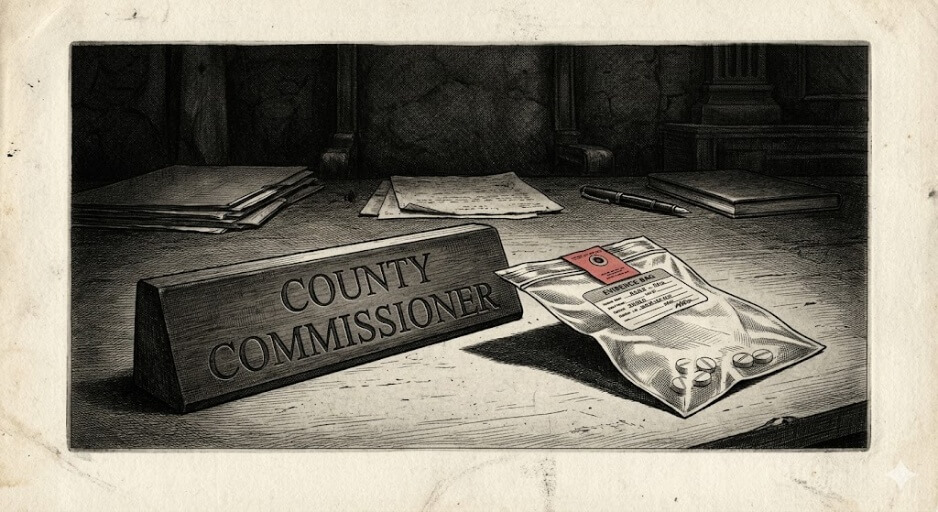
Lehigh County Commissioner Zachary Borghi, a Democratic official in Pennsylvania, has been arrested and is facing dozens of felony charges following a protracted investigation into alleged drug activity. Authorities state that the charges are directly linked to his conduct, including during his tenure in local government. Borghi is currently being held in jail, having failed to post a $500,000 bail.
"The grand jury put him on our radar." — Gavin Holihan, Lehigh County District Attorney
The charges against Borghi are extensive, encompassing 89 counts of criminal use of a communication facility and multiple counts related to the delivery of controlled substances, specifically cocaine and psilocybin mushrooms. These allegations emerged from a detailed forensic analysis of Borghi’s cellphone and Apple iCloud data, an investigation that spanned nearly two years, from late 2023 through mid-2025, according to the Lehigh County District Attorney’s Office. Investigators assert that recovered messages reveal Borghi repeatedly coordinating drug transactions from various locations, including his own residence, a relative's home, and even within government buildings where he performed his official duties.
Among the most serious allegations is that Borghi arranged a drug transaction while actively participating in an official Lehigh County Board of Commissioners meeting. Prosecutors claim they have corroborated these communications by matching timestamps from the recovered messages with video footage of the meeting, thereby linking the alleged drug activity to that specific moment. Further allegations detail similar conduct during a public "Peace and Justice Symposium" event, raising additional questions about his actions while representing the community in an official capacity.
Lehigh County District Attorney Gavin Holihan stated that the case originated from a grand jury investigation that initially identified Borghi as a person of interest. "The grand jury put him on our radar," Holihan explained, adding that subsequent investigation uncovered more extensive evidence connecting Borghi to the alleged criminal activity. This current case is also connected to a broader multi-state investigation targeting a drug distribution network known as "Death Before Dirt," which reportedly operated across Pennsylvania, New York, Illinois, and Wisconsin. Borghi was among 22 individuals arrested in August 2025 as part of that wider probe.
In the initial August 2025 arrest, Borghi faced more limited charges related to marijuana possession and intent to deliver. He posted $50,000 bail at that time and was released, with court records sealed during the ongoing grand jury phase. Despite this initial arrest, Borghi was subsequently reelected to a second term as commissioner in November 2025. The current charges, however, represent a significant escalation from the earlier allegations. Unlike the previous case, the new accusations involve a broader pattern of alleged activity and more severe offenses tied to multiple controlled substances, as noted by Trending Politics.
Borghi has publicly denied all accusations. Following his initial arrest, he issued a statement asserting that he had never sold drugs and characterized the charges as politically motivated and a violation of his constitutional rights. He has also indicated his intention to vigorously contest the case in court. Since his second arrest, Borghi has been terminated from his position as commissioner. However, reports indicate that his name still appears on official county listings without updated details regarding his employment status.
The legal proceedings are now set to advance, with prosecutors tasked with proving the allegations through digital evidence and corroborating records. Defense attorneys are anticipated to challenge both the interpretation of the collected data and the broader claims of wrongdoing made by the prosecution. The unfolding case is expected to draw considerable public attention as it moves through the judicial system, impacting perceptions of local governance and the accountability of elected officials.