


⚡ BREAKING NEWS
Sponsor Advertisement
Trump Briefed on Alleged Iranian Leader's Sexual Orientation
AI Generated: Trump Briefed on Alleged Iranian Leader's Sexual Orientation

Trump Briefed on Alleged Iranian Leader's Sexual Orientation

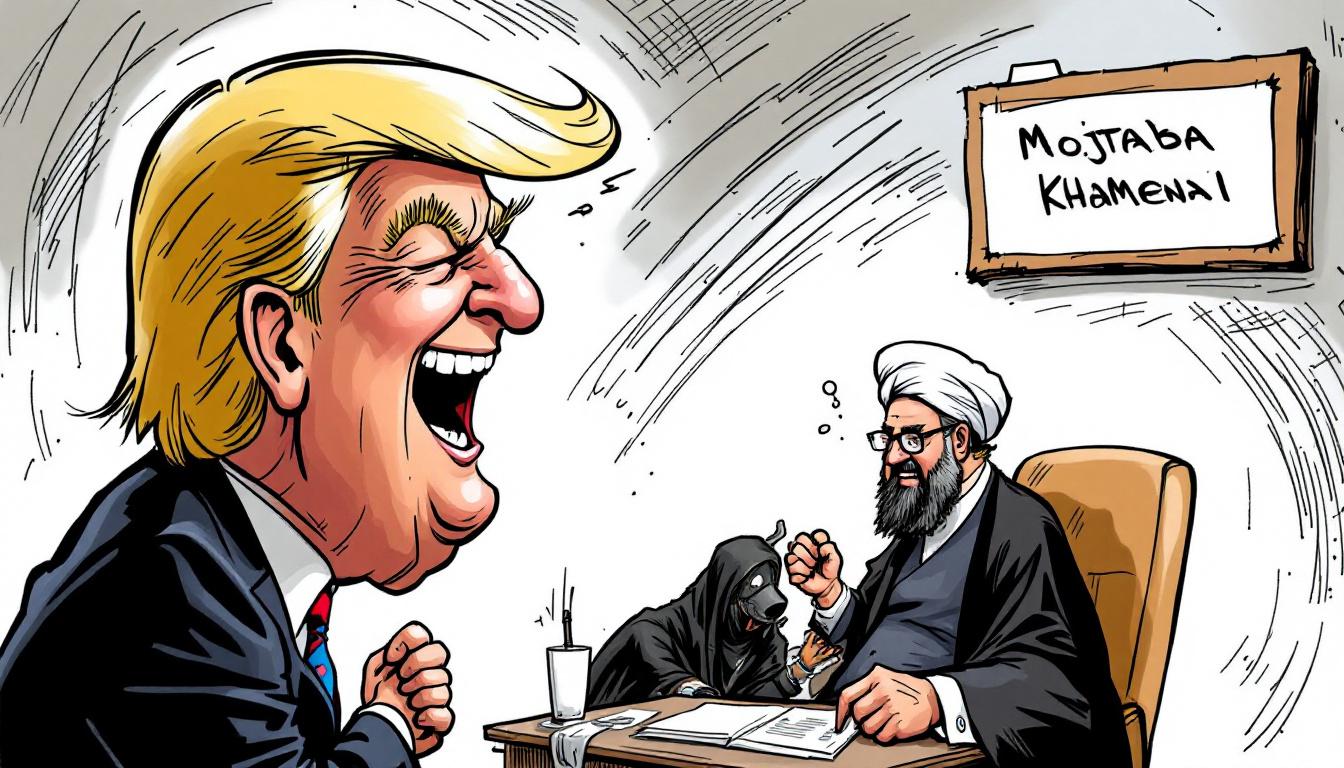
President Donald Trump reportedly reacted with laughter to intelligence suggesting Iran's new Supreme Leader, Mojtaba Khamenei, may be gay. The intelligence, deemed credible by U.S. agencies, emerges amid high U.S.-Iran tensions and strict anti-homosexuality laws in Iran.

President Donald Trump reportedly reacted with surprise and laughter last week during an intelligence briefing where officials presented information suggesting that Iran’s newly ascended Supreme Leader, Mojtaba Khamenei, may be gay. The briefing, which occurred in early March 2026, involved senior U.S. intelligence officials who detailed findings regarding Khamenei's personal life.

"If there was ever a time where it was OK to out someone, it would be a leader of a regime that executes people for being gay." — Source familiar with U.S. intelligence briefing

Sources familiar with the discussion indicated that the intelligence claim is considered credible by U.S. intelligence agencies and was not viewed as disinformation. According to these sources, President Trump laughed aloud when the information was presented, and others in the room also reportedly reacted with amusement. One senior intelligence official was noted to have continued joking about the revelation after the briefing concluded.

The intelligence reportedly suggests that Mojtaba Khamenei may have engaged in a long-term relationship with a man who served as his childhood tutor. Another source indicated the relationship might have involved a former employee connected to the Khamenei family. While U.S. officials reportedly do not possess photographic evidence to confirm these claims, sources familiar with the intelligence assert that it originated from a highly protected and reliable source. "The fact that this was elevated to the highest levels shows there is confidence in the information," one source stated, underscoring the weight given to the intelligence.

Rumors regarding Mojtaba Khamenei's personal life have reportedly circulated quietly within Iran for years. These whispers gained renewed prominence following the 2024 helicopter crash that killed Iranian President Ebrahim Raisi. Raisi had been widely considered a leading candidate to succeed Ali Khamenei as Iran’s supreme leader. Following the death of the elder Khamenei in a February 28, 2026 airstrike, Mojtaba was elevated to the position of Supreme Leader. He is also believed to have sustained injuries in the same attack that killed his father and other family members.

Further claims, cited by the New York Post, suggest Mojtaba Khamenei made "aggressive" sexual advances toward male caregivers while recovering from his injuries, possibly under the influence of heavy medication. Iranian officials have not publicly confirmed these allegations. However, a previously leaked diplomatic cable from 2008 reportedly referenced health issues related to Mojtaba Khamenei’s marriage, indicating he sought medical treatment in the United Kingdom for impotence before eventually fathering children. Despite these historical reports, his personal life has largely remained a closely guarded secret within Iran.

The implications of the intelligence are significant, particularly given Iran’s stringent laws against homosexuality. In Iran, homosexual acts are illegal and can carry severe penalties, including execution, under the country’s strict Islamic laws. Former Iranian President Mahmoud Ahmadinejad famously claimed in the past that “in Iran, we don’t have homosexuals.” Critics of the Iranian government have seized upon these laws, highlighting what they view as profound hypocrisy if the allegations concerning Mojtaba Khamenei prove to be true.

One source familiar with the intelligence briefing commented on the ethical considerations, stating, "If there was ever a time where it was OK to out someone, it would be a leader of a regime that executes people for being gay." This sentiment reflects a broader discussion about using such sensitive personal information in geopolitical contexts, especially against regimes with documented human rights abuses.

Mojtaba Khamenei’s current location and medical condition remain unclear following the February 28 airstrike. He is widely anticipated to adopt a hardline stance against the United States and its allies, continuing the confrontational posture of the Iranian regime. President Donald Trump has previously criticized Mojtaba Khamenei, describing him as an “unacceptable” choice to lead Iran. This latest revelation about his alleged personal life comes at a time when tensions between the U.S. and Iran remain exceptionally high, exacerbated by recent events such as the launch of Operation Epic Fury. The intelligence surrounding Khamenei adds another layer of complexity to the already volatile relationship between the two nations.


Advertisement

The Flipside: Different Perspectives

Progressive View

The intelligence regarding Mojtaba Khamenei's alleged sexual orientation and President Trump's reported reaction raises complex ethical and humanitarian questions. While Iran's human rights record, particularly its brutal persecution of LGBTQ+ individuals, is unequivocally condemned, the weaponization of a person's private life, even that of an adversary, requires careful consideration. Progressives emphasize the importance of human dignity and privacy, even for those in positions of power within oppressive regimes. The act of "outing" someone, regardless of their political role, can have severe consequences, potentially reinforcing harmful stereotypes or setting a precedent for future intelligence operations that disregard personal autonomy.
Moreover, focusing on a leader's alleged sexual orientation risks diverting attention from the systemic issues of the Iranian regime, such as its authoritarian governance, nuclear program, and regional destabilization efforts. While the hypocrisy of a regime that executes gay individuals while its leader is allegedly gay is stark, the priority should remain on advocating for human rights and systemic change within Iran, rather than personal attacks. An empathetic and analytical approach would involve condemning Iran's homophobic laws while also questioning the ethical implications of how such intelligence is gathered, disseminated, and leveraged on the global stage. True progress involves upholding human rights principles consistently, without selectively applying them based on political expediency.

Conservative View

The reported intelligence regarding Iran's new Supreme Leader, Mojtaba Khamenei, and President Trump's reaction, highlights a critical intersection of national security and the moral imperative to confront oppressive regimes. From a conservative perspective, the focus remains squarely on Iran's actions as a state sponsor of terrorism and its severe human rights abuses, particularly its barbaric laws against homosexuality. If the intelligence is credible, it exposes a profound hypocrisy at the highest levels of a regime that routinely executes individuals for the very acts its leader allegedly engages in. This revelation could potentially destabilize an already volatile leadership, creating an opportunity for the U.S. to further expose the regime's illegitimacy. Conservatives believe in confronting tyranny and supporting individual liberties globally. The alleged personal life of a leader who condones such atrocities underscores the need for continued pressure and sanctions against the Iranian government, not only for its nuclear ambitions and regional destabilization but also for its egregious human rights violations. The U.S. must prioritize its national security interests and the defense of universal human rights, even if it means leveraging sensitive information to expose the moral bankruptcy of adversaries. This situation underscores the importance of strong intelligence gathering and decisive leadership in foreign policy.

Common Ground

Despite differing approaches, both conservative and progressive viewpoints share common ground in their condemnation of Iran's severe human rights abuses, particularly its laws that criminalize and punish homosexuality with extreme brutality. There is bipartisan agreement on the need to hold the Iranian regime accountable for its actions, including its support for terrorism, its nuclear ambitions, and its oppressive treatment of its own citizens. Both sides can agree that the alleged hypocrisy at the highest levels of the Iranian government, if true, further undermines its moral authority and internal legitimacy. A shared goal is to promote human rights and stability in the Middle East. Constructive bipartisan approaches could involve strengthening international coalitions to pressure Iran on its human rights record and nuclear program, while also exploring diplomatic avenues that could lead to verifiable changes in its behavior. Furthermore, both perspectives can acknowledge the strategic value of intelligence in understanding adversaries, even while debating the ethical parameters of its use. Ultimately, the shared objective is to counter a dangerous regime and advocate for a more just and peaceful world, even if the methods to achieve that goal vary.