
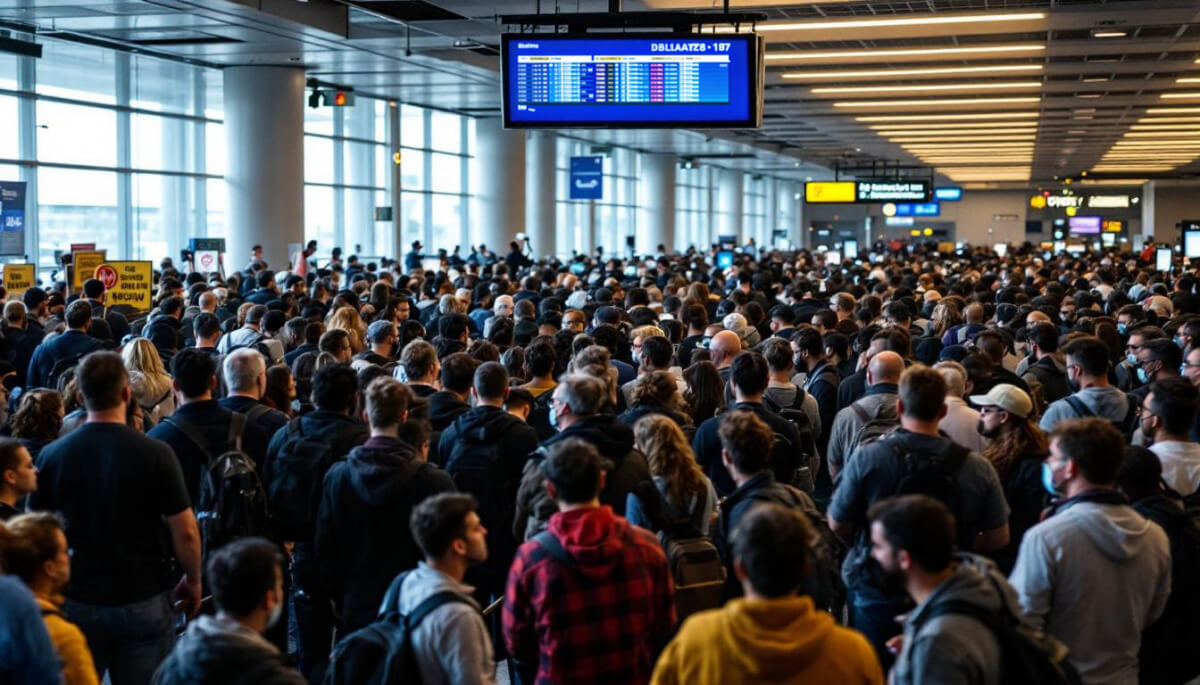
Airports across the United States are experiencing significant disruptions as the partial government shutdown continues, leading to widespread staffing shortages within the Transportation Security Administration (TSA). Thousands of TSA employees, deemed essential, have now missed their second paycheck, exacerbating operational challenges and creating extensive wait times for passengers ahead of the busy Spring Break travel period.
"Very serene." 4-hour long lines. Hundreds of missed flights. Financial hardship for TSA officers." — Department of Homeland Security
The deepening crisis became particularly evident on Friday morning at Austin-Bergstrom International Airport in Texas, where security lines stretched outside the terminal building. Travelers began queueing as early as 4:30 a.m., approximately 90 minutes after security checkpoints opened, facing 47-degree temperatures under the moonlight. Video footage from the scene depicted long lines snaking outdoors, with passengers bundled up against the cold. By 7:30 a.m., lines had moved inside, but checkpoints remained heavily congested and slow. Airport officials in Austin anticipated over 35,000 passengers would pass through on Friday alone.
Similar delays and long security lines have been reported at other major airports, including Atlanta, Charlotte, New Orleans, and Houston. The escalating situation has prompted airport authorities to advise travelers to arrive significantly earlier than usual: domestic passengers are now urged to arrive 2.5 hours before departure, while international travelers are advised to allow three hours, an increase from the standard two-hour recommendation for domestic flights.
These widespread disruptions are a direct consequence of the ongoing partial government shutdown, which has impacted the Department of Homeland Security (DHS), the parent agency of the TSA. Approximately 50,000 TSA employees, who are working without pay, have now gone without their second scheduled paycheck. Reports, including those cited by the Daily Mail, indicate that the severe financial strain is beginning to affect staffing levels, with some TSA workers reportedly calling out of work or even resigning from their positions. This reduction in available personnel places additional pressure on an already strained system as passenger volumes continue to rise.
The political impasse driving the shutdown centers on funding for the Department of Homeland Security. Lawmakers in Congress remain deadlocked over a funding deal, with Democrats advocating for operational changes to Immigration and Customs Enforcement (ICE) and Customs and Border Protection (CBP) as part of a broader agreement. Republicans, however, have firmly rejected these demands, asserting they will not support any measure that could be perceived as weakening immigration enforcement efforts. Senator Brian Schatz indicated that negotiations are ongoing but acknowledged that lawmakers remain far apart on reaching a resolution.
The shutdown unfolds amidst heightened tensions surrounding immigration policy, including recent protests against ICE in Minneapolis that tragically resulted in the deaths of two individuals, Renee Good and Alex Pretti. This context has added further pressure to the debate concerning immigration enforcement and border security. The political fallout has also led to leadership changes within the Department of Homeland Security. President Donald Trump recently announced the replacement of Homeland Security Secretary Kristi Noem with Senator Markwayne Mullin, who is expected to assume the role later this month.
In response to the growing airport chaos, the Department of Homeland Security has attributed the funding standoff to Democrats, stating that it has caused "hours-long security lines at airports across the country." The TSA has also issued a public message, appealing to travelers for patience and understanding towards its employees who continue to report for duty despite the financial hardship of working without pay. Officials have warned that the delays are likely to intensify further as the Spring Break travel rush brings an increasing number of passengers to airports in the coming days. The immediate impact on travelers and the financial strain on essential workers underscore the significant consequences of the unresolved political dispute.