


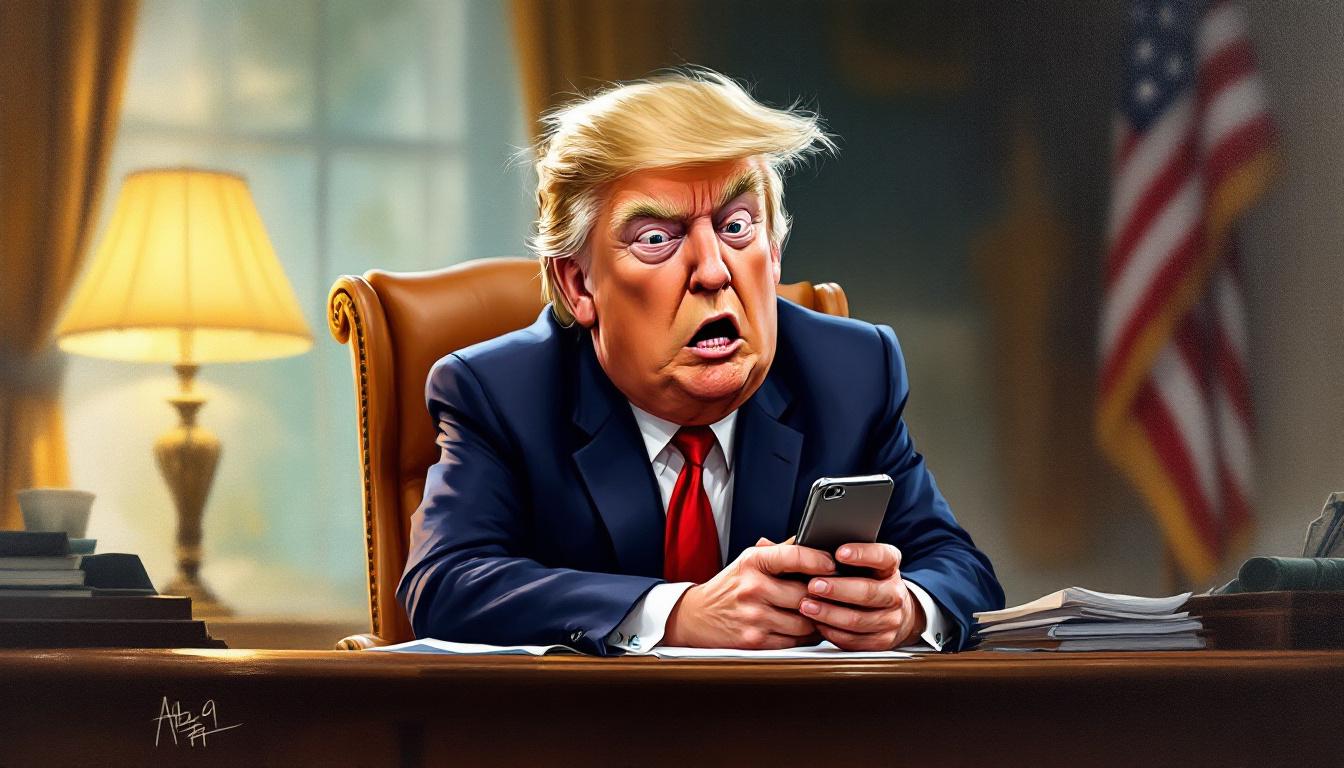
Recent reports have brought to light alleged private online activities of Bryon Noem, the husband of Kristi Noem, the former Secretary of the Department of Homeland Security. These revelations have swiftly raised questions among security experts regarding potential national security risks, particularly for individuals connected to high-level government officials. President Donald Trump, when queried about the situation, expressed surprise and stated he was previously unaware of the claims.
"They confirmed it? Wow, well, I feel badly for the family if that’s the case. That’s too bad,” President Trump told the Daily Mail. “I haven’t seen anything. I don’t know anything about it. That’s too bad, but I just know nothing about it.”" — President Donald Trump, United States President
The reports detail allegations that Bryon Noem engaged in explicit online behavior. Specifically, it is claimed that he sent photos of himself dressed in women’s clothing and communicated with accounts associated with adult content online. Furthermore, the reports suggest that he transferred at least $25,000 to various individuals through online payment platforms. The surfacing of these claims has shifted public discourse from purely personal conduct to the broader implications for national security, especially considering Kristi Noem’s significant past and present roles within the government.
President Donald Trump addressed the allegations, indicating his lack of prior knowledge about the situation. "They confirmed it? Wow, well, I feel badly for the family if that’s the case. That’s too bad,” President Trump told the Daily Mail. “I haven’t seen anything. I don’t know anything about it. That’s too bad, but I just know nothing about it.” President Trump did not expand further on whether he believed the situation had any specific impact on Kristi Noem’s tenure in government, reiterating his unawareness of the details.
Kristi Noem recently held the prominent position of Secretary of the Department of Homeland Security (DHS), a role that involves access to highly sensitive information and critical national security matters. She was reportedly removed from this position following criticism tied to immigration enforcement policies and internal disputes within the department. Subsequently, she has taken on a new role focused on Western Hemisphere security. The timing of these recent reports has intensified scrutiny over her past tenure and judgment while in office, as highlighted by various media outlets including the Daily Mail. The proximity of such personal controversies to high-stakes government roles often draws significant public and expert attention due to the potential for vulnerabilities.
Security experts cited in the reports have underscored that undisclosed personal behavior of this nature can create substantial vulnerabilities, particularly for individuals associated with high-level government positions who may have access to or influence over classified information. The primary concern revolves around the potential for foreign adversaries or other malicious actors to exploit such hidden matters. This exploitation could manifest as leverage, where private information is used to coerce or blackmail individuals, thereby influencing decision-making or extracting sensitive national security information.
Officials familiar with the stringent standards for security clearances consistently emphasize that the core issue is not necessarily the specific behavior itself, but rather whether it was disclosed to relevant authorities and whether it creates a demonstrable risk of coercion or undue influence. A source indicated that knowledge of such activity, if it remained undisclosed, could significantly affect an individual's eligibility for top-level security clearance. This principle underscores that any undisclosed vulnerabilities are taken with utmost seriousness in national security evaluations, applying broadly across intelligence, defense, and law enforcement agencies tasked with protecting classified information and national interests.
Bryon Noem has issued a response to certain aspects of the report. While he denied that his actions created any risk to national security, he notably did not dispute all elements of the alleged online behavior. This partial response has left open questions regarding the full scope of the situation and whether any further details remain undisclosed, contributing to ongoing public and expert discussions.
At this stage, there is no public indication that classified information has been compromised as a direct result of these claims, nor has any formal investigation been launched specifically in response to these recent reports. Nevertheless, the situation serves as a stark reminder of the complex and often sensitive intersection between personal conduct and national security, especially when it involves individuals closely connected to high-level government roles. The discussions surrounding these events highlight the rigorous expectations for transparency and the potential vulnerabilities that can arise from undisclosed personal matters within the sphere of public service. The reports also referenced previously circulated allegations involving Kristi Noem and political adviser Corey Lewandowski, which have been denied over the years; however, no new evidence has been presented in conjunction with the current revelations to tie these older claims directly to national security concerns.

