


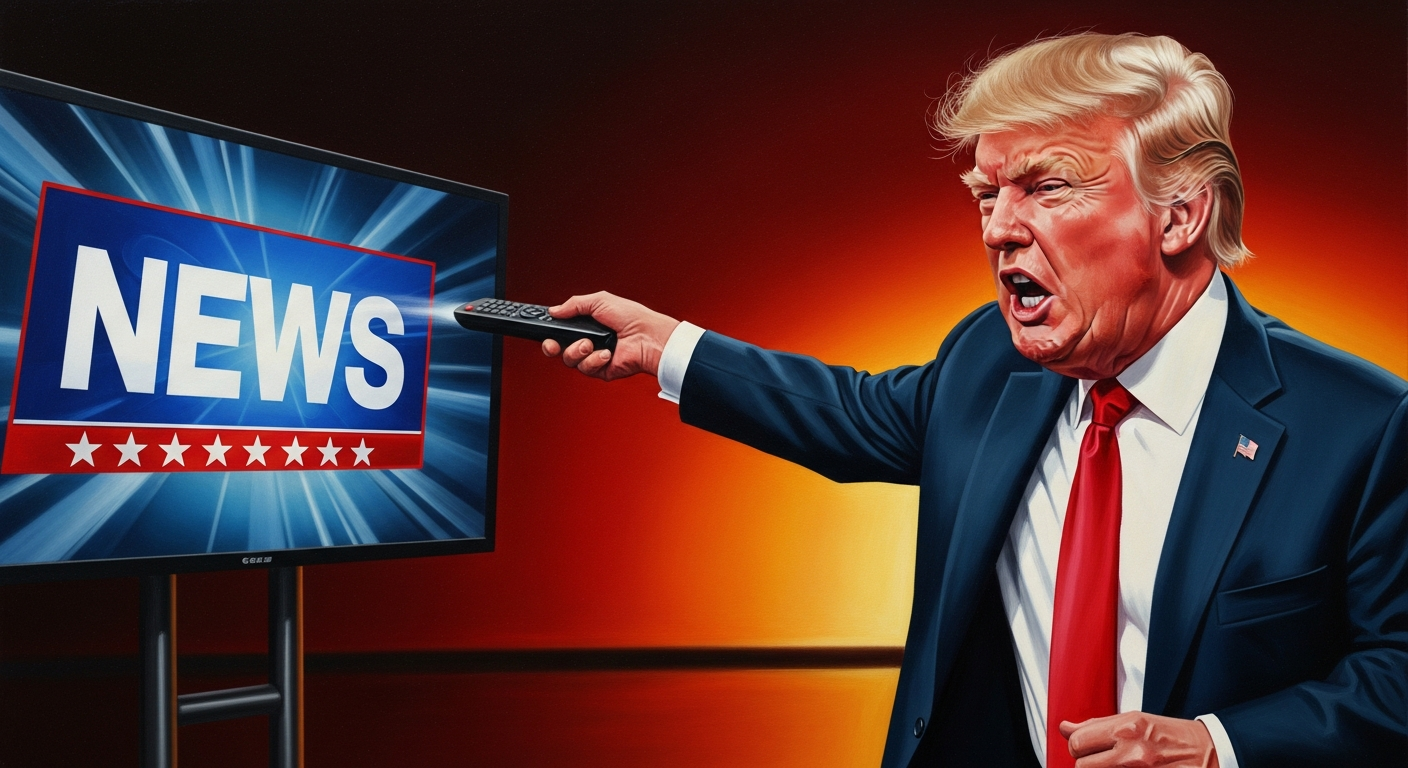
President Donald Trump has publicly escalated his criticism of Fox News, targeting two prominent hosts, Shannon Bream and Jessica Tarlov, through posts on Truth Social. In his remarks, President Trump accused Bream of conducting interviews that allowed Democratic perspectives to go unchallenged and called for the outright termination of Tarlov, labeling her commentary as misleading and detrimental to viewers. Neither Fox News nor the named hosts have issued public statements in response to President Trump's criticisms.
"She is, from her voice to her lies, one of the worst personalities on television." — President Donald Trump, Truth Social
The focus of President Trump's dissatisfaction with Shannon Bream, anchor of "Fox News Sunday," stemmed from her recent interview with Representative Jake Auchincloss (D-MA). During the segment, Rep. Auchincloss offered critiques of President Trump's foreign policy, specifically referencing "Operation Epic Fury." Auchincloss reportedly claimed this strategy inadvertently strengthened Iran by granting it greater control over the Strait of Hormuz. He also drew unfavorable comparisons between President Trump’s foreign policy approach and his administration's trade negotiations with China. President Trump contended that Bream's interview failed to adequately challenge these assertions, characterizing them as partisan talking points rather than objective analysis.
Additionally, President Trump took issue with Bream's phrasing when discussing Republican-backed legislation. He stated that Bream referred to the "Save America Act" simply as the "Save Act," a simplification he argued minimized the significance of the legislative measure. President Trump emphasized the importance of precise language in media, suggesting that even minor alterations in wording can influence public perception and understanding of political initiatives.
Jessica Tarlov, a left-leaning commentator frequently featured on Fox News panel shows, particularly "The Five," received President Trump’s sharpest condemnation. President Trump asserted that her commentary misleads viewers and unequivocally demanded her removal from the network. He wrote, "She is, from her voice to her lies, one of the worst personalities on television," directly urging Fox executives to take action. This latest public demand follows a prior instance where President Trump, during a call-in to "The Five" when Tarlov was absent, highlighted what he perceived as inaccuracies in polling data and reiterated his disapproval of her on-air contributions.
These recent comments underscore a persistent tension between President Trump and certain voices within Fox News, even as he continues to make appearances on the network and expresses approval for other segments and personalities. The network's decision on whether to address President Trump’s remarks publicly or to adjust its programming balance remains unstated.
Media analysts suggest that President Trump's use of Truth Social for direct, real-time responses to media coverage aligns with his broader strategy to influence conservative discourse and hold media organizations accountable for content he views as biased. By publicly singling out prominent hosts, President Trump signals an expectation for stronger advocacy of Republican positions and a more confrontational stance against liberal commentary on platforms traditionally aligned with conservative audiences.
The situation places Fox News in a challenging position: balancing its stated commitment to offering diverse viewpoints with the demands emanating from one of the most influential figures within the conservative movement. Given President Trump's substantial influence over the conservative base, the network faces increased scrutiny from its viewership and external commentators regarding its programming decisions and editorial independence.
The ongoing friction between President Trump and elements within Fox News is likely to fuel broader discussions about media bias, the responsibilities of journalistic organizations, and the evolving dynamics between political leaders and major news platforms. President Trump's direct public rebuke serves as a vivid reminder of the high stakes involved in contemporary political media and the significant impact that outspoken political leadership can have on shaping public debate and media narratives. The episode highlights the complex interplay of political influence, media strategy, and public perception in the modern information landscape.

