


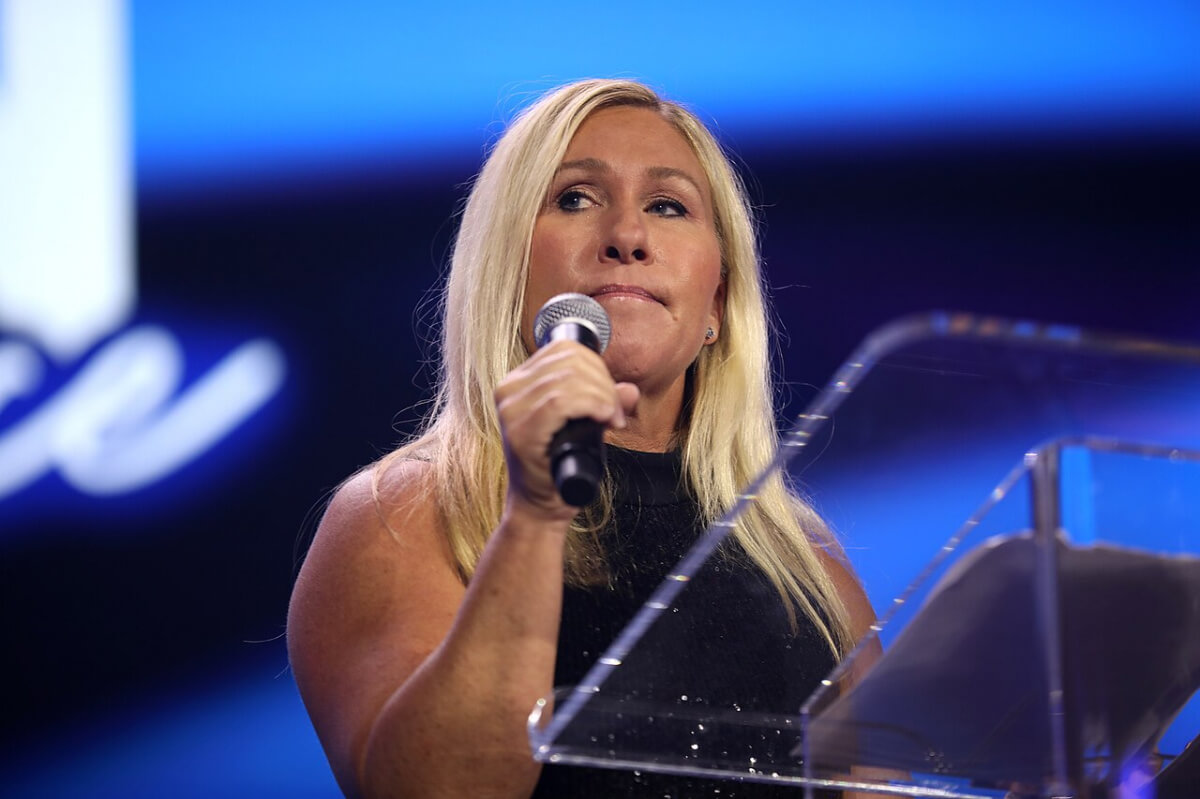
On April 7, the day voters in Georgia's 14th Congressional District participated in a special election to fill a vacant House seat, former Representative Marjorie Taylor Greene publicly demanded President Donald Trump's removal from office under the 25th Amendment. Greene's call came in response to a social media post by President Trump concerning Iran, which she characterized as "evil and madness."
"25TH AMENDMENT!!! Not a single bomb has dropped on America. We cannot kill an entire civilization. This is evil and madness." — Former Representative Marjorie Taylor Greene
The catalyst for Greene's statement was a Truth Social post issued by President Trump earlier that Tuesday. In his post, President Trump issued a stark warning to Iran, stating that the country's "whole civilization will die tonight" unless "something revolutionarily wonderful" occurred. He linked this warning to what he described as "Complete and Total Regime Change," asserting that "47 years of extortion, corruption, and death, will finally end." President Trump informed his followers that the world would witness the outcome by Tuesday night, framing the moment as "one of the most important moments in the long and complex history of the World."
Shortly after President Trump's post, Greene took to X (formerly Twitter) to voice her strong disapproval. Her post read: "25TH AMENDMENT!!! Not a single bomb has dropped on America. We cannot kill an entire civilization. This is evil and madness." The constitutional mechanism Greene invoked, the 25th Amendment, addresses presidential disability and succession. Specifically, Section Four of the 25th Amendment allows the Vice President and a majority of the Cabinet to declare the President "unable to discharge the powers and duties of his office," at which point those powers and duties would temporarily transfer to the Vice President. Should such a declaration occur, Congress would then have the authority to act, with lawmakers able to "determine by a two-thirds vote whether to permanently remove the President or to return the President to his duties."
Greene's demand unfolded as her former constituents were casting ballots in a special election to determine who would succeed her in Georgia's 14th Congressional District. Greene resigned from Congress in January, creating the vacancy. For this special election, President Trump had publicly endorsed Clay Fuller, whom he described as an "America First Patriot," since February. Fuller's background includes service as district attorney for the Lookout Mountain Judicial Circuit and holding the rank of lieutenant colonel as deputy staff judge advocate in the Air National Guard. President Trump had expressed his expectation that Fuller would advance the administration's agenda upon entering the House. The night before the election, President Trump extensively promoted Fuller, writing: "There is a very important Special Election tomorrow, Tuesday, April 7th, in Georgia’s 14th Congressional District! I am asking all Republicans, America First Patriots, and MAGA Warriors, to please GET OUT AND VOTE for a fantastic Candidate, Clay Fuller, who has my Complete and Total Endorsement!" He also provided specific voting instructions, including poll hours.
The tension between Greene and President Trump is not a recent development. Breitbart Editor-in-Chief Alex Marlow described Greene's decision to resign from Congress in November as "deeply selfish," arguing it deprived Republicans of a crucial House vote. Since her departure from Congress, Greene has consistently made President Trump's Iran policy a focal point of her public criticism of the administration. In March, during an appearance on CNN, she characterized President Trump's military posture toward Iran as a "perverted, deranged version" of the "Make America Great Again" (MAGA) platform. She stated, "This is not what we campaigned for. We said on every single rally stage, no more foreign wars, no more regime change. It’s time to put America first." Greene further escalated her critique, asserting that President Trump's actions represented "100% a betrayal" of the mandate voters entrusted to him in 2024. During an interview on 60 Minutes, Greene argued that a president committed to America First priorities should prioritize domestic policy, an area she suggested President Trump had not sufficiently focused on.
Greene's anti-war stance has also led her to forge connections with unexpected allies. In December, CODEPINK cofounder Medea Benjamin visited Greene's Capitol Hill office and subsequently praised her as a "strong anti war voice in congress." Greene acknowledged this relationship, stating she had "enjoyed a friendship" with Benjamin "for a few years" and was "fully against funding foreign wars."
President Trump has shown no inclination toward reconciliation with Greene. He publicly welcomed her congressional exit as "great news for the country," asserting she was "not AMERICA FIRST or MAGA." He has also referred to her as "Marjorie ‘Traitor’ Brown" and characterized her as "a very dumb person." The former Representative's latest demand for President Trump's removal underscores a deepening public rift between the two prominent Republican figures, particularly concerning foreign policy and constitutional powers.

