


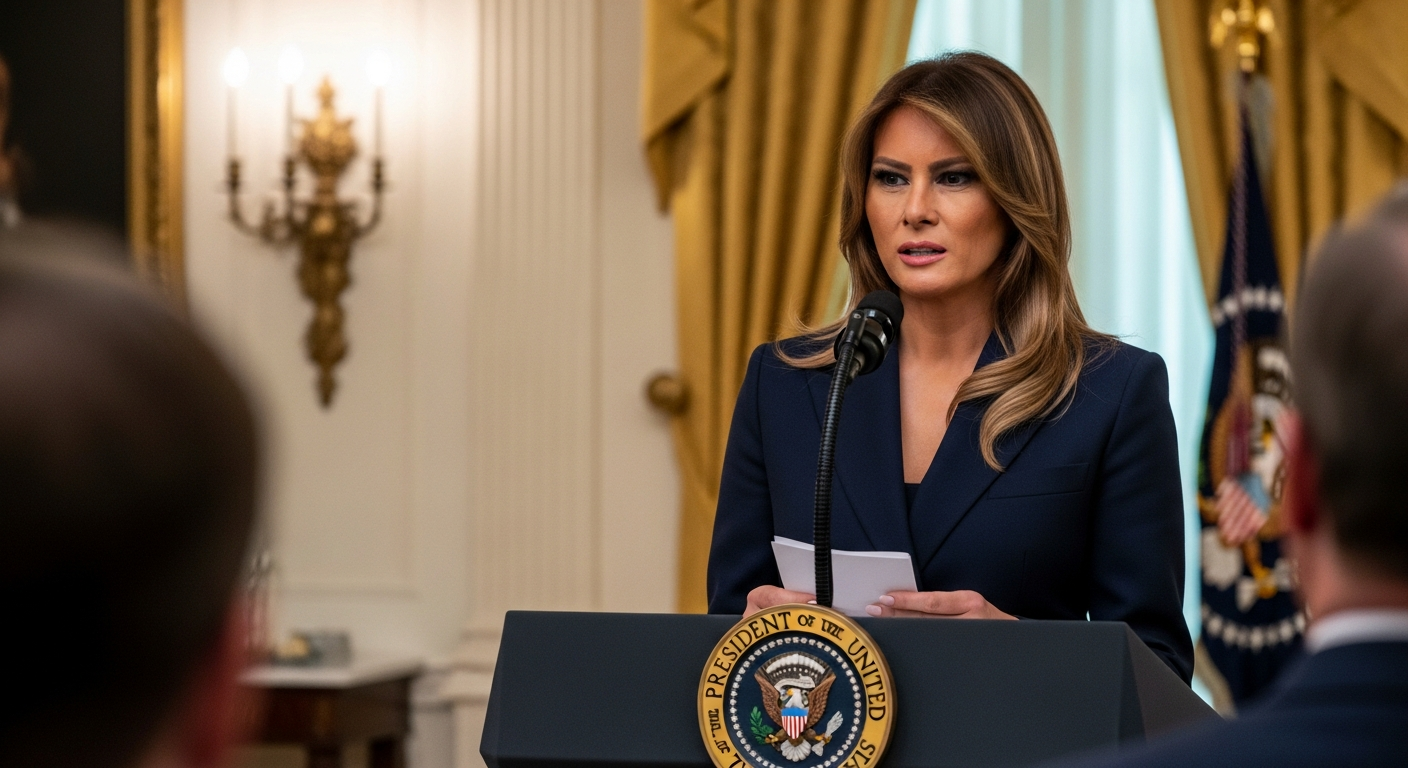
First Lady Melania Trump delivered an unannounced public statement from the White House's Cross Hall, forcefully denying long-circulating allegations connecting her to the late financier Jeffrey Epstein. The unexpected address reportedly caught President Donald Trump off guard, raising questions about coordination within the administration.
For years, unsubstantiated claims and online rumors have attempted to link Mrs. Trump to Epstein, a convicted sex offender who died in federal custody in 2019. These allegations often centered on her social circles in New York and Palm Beach prior to her marriage to President Trump, and occasionally involved Epstein's associate Ghislaine Maxwell, who was convicted of sex trafficking. While the First Lady has largely maintained a private profile during her husband's presidency, her decision to address these specific allegations publicly and without prior announcement marked a significant departure from her typical approach.
"I am not Epstein’s victim." — First Lady Melania Trump
During her remarks, Mrs. Trump directly confronted several key allegations that have been circulating online. "I am not Epstein’s victim," she stated unequivocally, pushing back against claims that she was among those exploited by the financier. She also directly refuted suggestions that Epstein played any role in introducing her to President Trump. "Epstein did not introduce me to Donald Trump. I met my husband by chance at a New York City party in 1998," she clarified, providing a specific detail about her initial encounter with the President.
The First Lady further emphasized her lack of close ties to Epstein or Maxwell. "I have never been friends with Epstein," she asserted, explaining that any overlap in social circles was "common" in high-society environments like New York and Palm Beach, where many public figures often attend the same events. She also addressed an email exchange with Maxwell that had previously resurfaced in public files. Mrs. Trump dismissed its significance, stating, "My polite reply to her email doesn’t amount to anything more than a trivial note," suggesting it held no deeper meaning or connection.
Mrs. Trump went on to accuse critics of disseminating "false smears" for political and financial motivations, urging the public to be wary of misinformation. "These images and stories are completely false," she added, underscoring her stance that the allegations were unfounded and malicious attempts to discredit her.
The timing of the First Lady's speech garnered particular attention, as there had been no recent new revelations or significant developments in the Epstein case directly linking her to the financier that would immediately prompt such a public statement. An advisor to Mrs. Trump indicated that the decision to speak out was driven by a sense that "enough is enough" and that "the lies must stop," suggesting a culmination of frustration over the persistent rumors and their impact.
Reports from the Daily Mail indicated that Mrs. Trump appeared visibly tense during her address, reading from notes and largely avoiding direct eye contact with the camera throughout her delivery. She concluded her remarks without taking any questions from the press and quickly exited the room, leaving a lingering sense of uncertainty and prompting further discussion about the motivation and strategy behind her sudden public appearance.
Perhaps the most striking development following the First Lady's address was President Trump's reaction. Speaking to MS Now, President Trump claimed he was entirely unaware of his wife's intention to make the statement. He stated, "I didn’t know anything about" Melania’s speech before it happened. The President then abruptly ended the conversation, insisting that Melania "didn’t know [Epstein]," thereby shutting down further questioning on the matter. This admission from President Trump that he was "blindsided" by the First Lady's public remarks has fueled speculation regarding the level of communication and coordination within the White House administration and the potential implications for public perception.
Despite her forceful denials of any personal involvement, Mrs. Trump also used her platform to call for action on behalf of Epstein's victims. "I call on Congress to provide the women who have been victimized by Epstein with a public hearing," she urged, pivoting from her personal defense to a broader appeal for justice for those affected by Epstein's crimes. This call for congressional hearings aligns with ongoing efforts to ensure accountability and support for victims of sexual exploitation and represents a significant policy recommendation from the First Lady. The unusual circumstances surrounding the delivery of the speech and the President's subsequent reaction have ensured the statement remains a topic of significant public and political discussion.

