


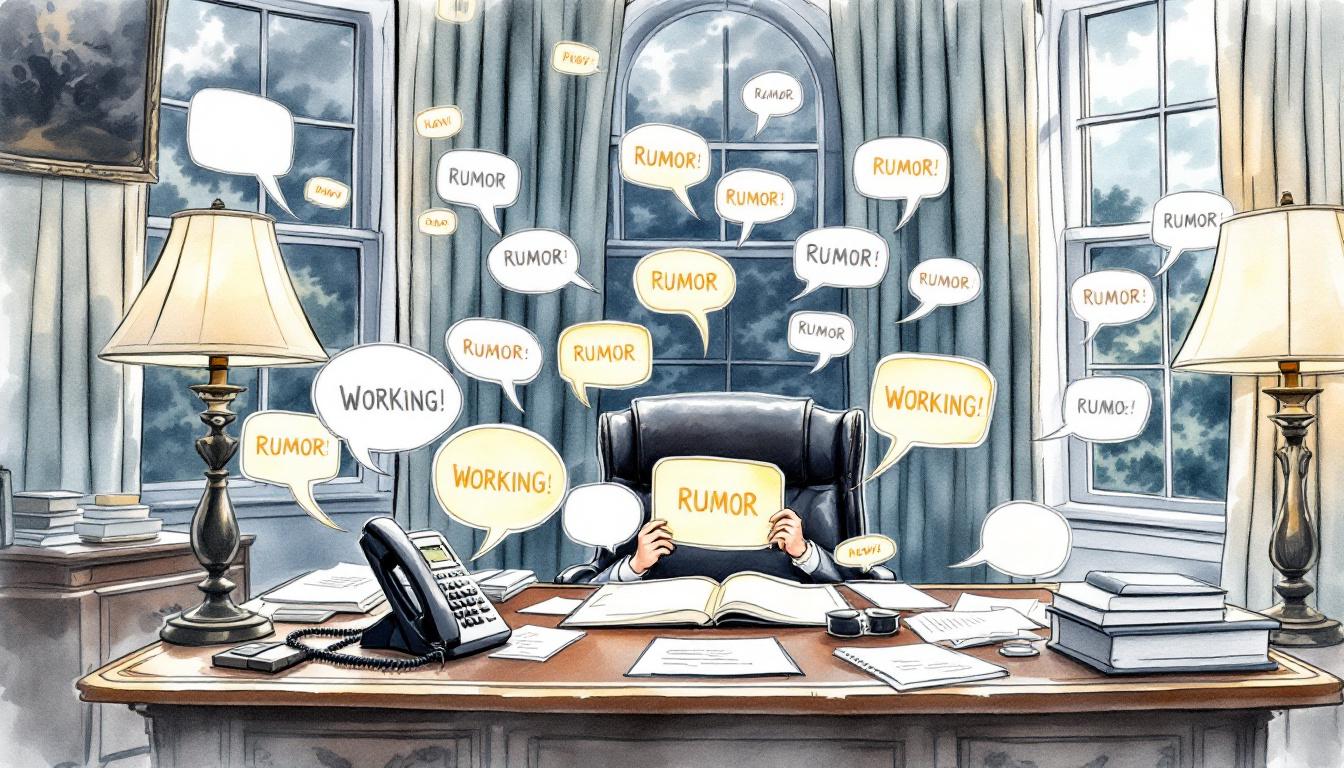
The White House moved quickly to counter widespread online rumors on Sunday, firmly dismissing speculation that President Donald Trump had been hospitalized. Officials confirmed President Trump remained at the White House throughout the day, actively working and conducting his duties from the Oval Office. The speculation, which spread rapidly across social media platforms, was attributed to a misinterpretation of a standard White House procedural announcement.
"The president had not left the White House and dismissed the claims as false. He emphasized that Trump had been working throughout the day in the Oval Office, framing the speculation as unfounded and misleading." — Steven Cheung, White House Communications Director
The rumors began circulating late Sunday morning following a routine "press lid" notification issued by the White House. In Washington D.C. press corps terminology, a "press lid" is a common announcement signaling that the president has no further public events scheduled for the remainder of the day. It is a standard practice designed to inform journalists about the president's availability and schedule, allowing them to anticipate their own reporting needs. However, this routine notification was taken out of context by several social media accounts, which began propagating unverified claims that President Trump had been rushed to Walter Reed National Military Medical Center.
The unsubstantiated claims gained significant traction online, with posts alleging a medical emergency spreading despite a complete lack of official confirmation or supporting evidence. Crucially, there were no reports of a presidential motorcade, which typically accompanies the President for any off-site movement and involves heightened security protocols and temporary road closures. Furthermore, no official alerts were issued by the White House, the Secret Service, or any other relevant government agency. Members of the White House press pool, who closely monitor presidential activity, also reported no unusual movements or emergency situations.
Reporters and White House observers on site quickly pushed back against the circulating rumors. One of the clearest and most immediate indicators that President Trump was at the White House came from standard security protocol: a U.S. Marine sentry was visibly stationed outside the West Wing entrance. The presence of a Marine sentry at this post typically signifies that the President is inside the White House complex and actively engaged in work. Journalists present confirmed the sentry’s presence and shared updates throughout the afternoon, further undermining the online claims.
Additional reporting also directly contradicted the hospitalization rumors. Checks with Walter Reed National Military Medical Center revealed no unusual activity. A presidential visit to Walter Reed would invariably trigger a significant increase in security measures, visible motorcade movements, and often, road closures in the surrounding area. None of these indicators were present, providing a strong factual counterpoint to the online speculation.
In response to the escalating rumors, the White House issued a formal statement directly addressing the situation. Steven Cheung, the White House Communications Director, confirmed unequivocally that President Trump had not left the White House. He explicitly dismissed the claims as false, stating that President Trump had been working throughout the day in the Oval Office. Cheung characterized the online speculation as unfounded and misleading, emphasizing the President's continued engagement in his duties.
The rapid spread of these unverified claims highlights the persistent challenge of misinformation, particularly when routine government procedures are taken out of their proper context. A "press lid," while common in the capital, was sufficient to trigger widespread speculation when misinterpreted by those unfamiliar with its meaning or those seeking to spread unverified information. The timing of the rumors also played a a role in their dissemination. President Trump did not travel to his Mar-a-Lago estate for the Easter weekend, a deviation from his typical pattern. This departure from routine, combined with the press lid announcement, created a vacuum that was quickly filled with speculation and unconfirmed reports.
These rumors unfolded against a backdrop of escalating international tensions, particularly in the Middle East. The United States remains engaged in an ongoing conflict with Iran, with military operations and diplomatic developments occurring daily. Earlier on the same day, President Trump had reiterated a 48-hour deadline for Iran to reopen the Strait of Hormuz, issuing a stern warning of potential further escalation if the demands were not met. Concurrently, search efforts were underway for a missing U.S. airman following an incident involving an F-15 aircraft over southwest Iran. Reports had also indicated recent strikes in Tehran that reportedly resulted in the deaths of multiple Iranian leaders, adding to the already intense geopolitical environment.
In such a volatile international climate, any uncertainty regarding the President’s condition or whereabouts can carry magnified weight. Even unverified claims about the President's health or location can gain rapid traction, especially during periods of heightened national security concerns and geopolitical instability. The White House's swift and clear response aimed to mitigate the potential impact of such misinformation on public perception and national stability.

