


⚡ BREAKING NEWS
Sponsor Advertisement
Trump Faces Backlash Over Jesus Comparison During Holy Week
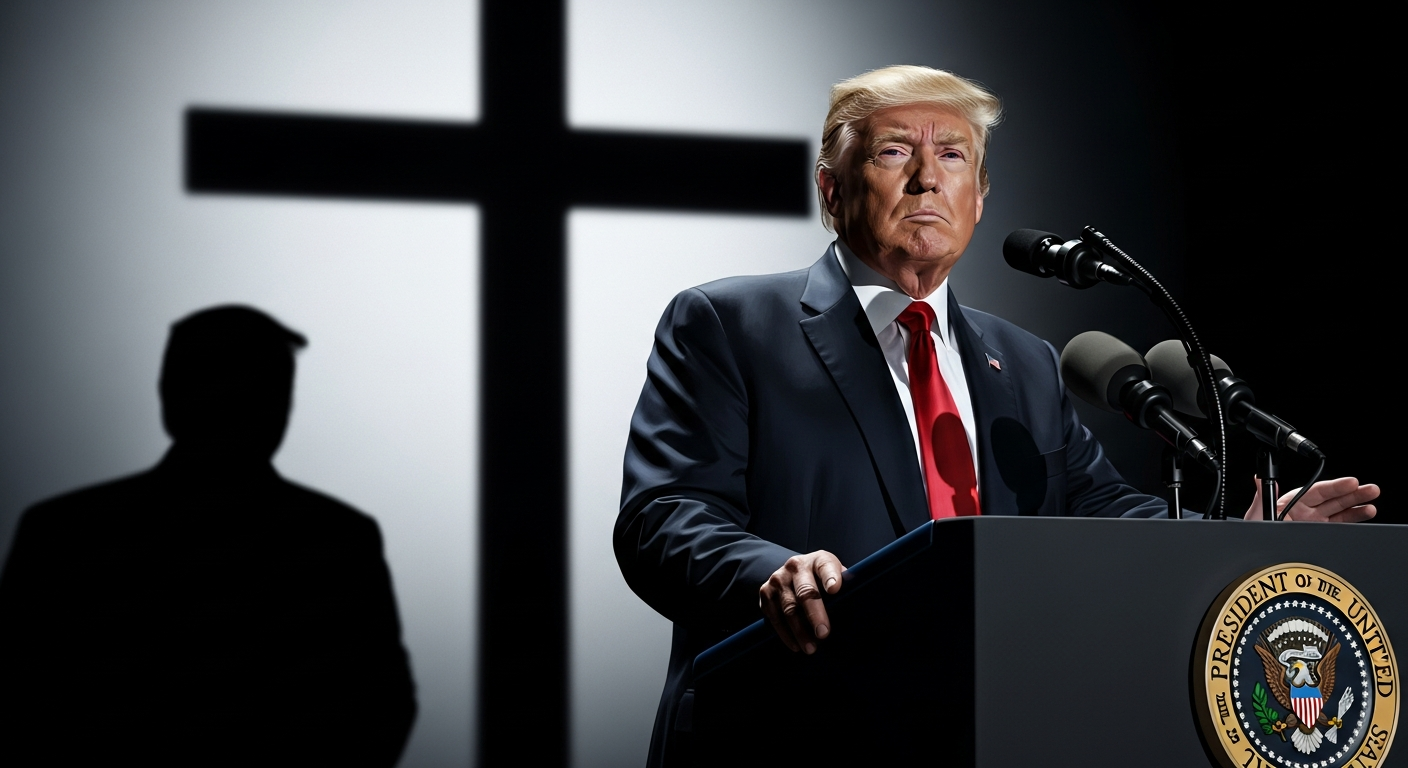
AI-generated image for: Trump Faces Backlash Over Jesus Comparison During Holy Week

Trump Faces Backlash Over Jesus Comparison During Holy Week

President Donald Trump has drawn widespread criticism from religious leaders and Christians after making comments comparing himself to Jesus Christ during Holy Week. The remarks, made on Wednesday, April 2, 2026, have been labeled blasphemous by some observers.

President Donald Trump is facing significant criticism from religious leaders and Christians globally following remarks made during Holy Week, in which he appeared to compare himself to Jesus Christ. The comments, delivered on Wednesday, April 2, 2026, at the White House, have ignited a debate about the intersection of religious veneration and political rhetoric, particularly during one of Christianity's most sacred observances.

"Mr. President, no one has paid the price like you have paid the price. It almost cost you your life. You were betrayed and arrested and falsely accused. It’s a familiar pattern that our lord and savior showed us." — Paula White-Cain, White House Spiritual Adviser

Holy Week, which culminates in Easter Sunday, commemorates the final days of Jesus Christ's life, his crucifixion, and resurrection. It begins with Palm Sunday, marking Jesus' triumphal entry into Jerusalem, and includes Good Friday, observing his crucifixion, and Holy Saturday, a day of vigil before Easter. For many Christians, this period is a solemn time of reflection on sacrifice, redemption, and faith.

According to now-deleted footage from the White House, President Trump spoke about Palm Sunday, recounting the biblical narrative. "On Palm Sunday, Jesus entered Jerusalem as crowds welcomed him with praise honoring him as king," President Trump stated. He then added, "They call me king now. Can you believe it?" These remarks quickly circulated online, drawing immediate condemnation from various Christian denominations and individuals.

Further exacerbating the controversy, White House spiritual adviser Paula White-Cain also drew parallels between President Trump and Jesus during the same event. White-Cain alluded to President Trump's legal and political challenges, likening them to the suffering endured by Jesus in Roman-ruled Jerusalem. "Mr. President, no one has paid the price like you have paid the price. It almost cost you your life. You were betrayed and arrested and falsely accused. It’s a familiar pattern that our lord and savior showed us," White-Cain said. She continued, "But it didn’t end there for him, and it didn’t end there for you." White-Cain further elaborated on the theme of divine intervention and victory, stating, "God always had a plan. On the third day, he rose, he defeated evil, he conquered death, hell and the grave. Because he rose we all know we can rise, and, sir, because of his resurrection you rose up. Because he was victorious, you were victorious. And I believe that the lord said to tell you this: Because of his victory, you will be victorious in all you put your hand to."

The comments from both President Trump and White-Cain have been widely interpreted by critics as blasphemous, a term referring to the act of insulting or showing contempt or lack of reverence for God or sacred things. Many Christians expressed profound discomfort with the comparison, arguing that it diminishes the unique divine status and sacrifice of Jesus Christ. For centuries, Christian theology has held Jesus as the Son of God, a figure whose suffering and resurrection are central tenets of the faith, distinct from any human leader or political figure.

Reactions on social media platforms were swift and largely negative. X users, in particular, voiced strong disapproval. One user, @MithaIntel, commented on April 2, 2026, stating, "At the very least, this is disrespectful towards Christians." Another user, @UStookit4tee5, wrote on the same day, "When are Americans going to wake up to this? The guy is ruining western civilisation for Israel and mocking our god as he does it. Fucking wake up." These sentiments reflect a broader concern among some religious individuals that the comments trivialized deeply held beliefs.

President Trump has historically cultivated strong support among evangelical Christians and religious conservatives, often positioning himself as a defender of religious liberty and traditional values. His campaigns have frequently emphasized a commitment to honoring Jesus and Christianity, making the current backlash particularly notable. The controversy emerges during a challenging period for the Trump administration, marked by surging oil prices amid the Iran war and recent high-profile personnel changes, including the firings of Kristi Noem and Pam Bondi. With midterm elections on the horizon, the political implications of alienating a key demographic could be a factor for the administration to consider as it navigates public opinion. The incident underscores the sensitive nature of religious discourse in the political arena and the fine line leaders must tread when invoking sacred figures and texts.


Advertisement

The Flipside: Different Perspectives

Progressive View

Progressives often view the comments made by President Trump and Paula White-Cain with significant concern, emphasizing the potential for blurring the lines between religious devotion and political loyalty. From this perspective, comparing a political leader, even a head of state, to Jesus Christ, particularly during Holy Week, risks sacrilege and can be seen as an attempt to imbue political power with divine authority. This raises alarms about the separation of church and state, a principle foundational to many progressive interpretations of American governance.

The progressive viewpoint also highlights the perceived hypocrisy in such statements. Many progressives argue that President Trump's policies and personal conduct often diverge sharply from the teachings of compassion, humility, and social justice central to Christian theology. Therefore, drawing parallels between him and Jesus is seen as deeply disrespectful to the faith itself and potentially manipulative. Critics from this perspective would contend that using religious figures for political gain can alienate genuinely devout individuals who believe faith should transcend partisan politics and focus on collective well-being and systemic equity. The emphasis is on the ethical implications of leadership and the importance of maintaining the integrity of religious belief systems free from political instrumentalization.

Conservative View

From a conservative perspective, the controversy surrounding President Trump's remarks and those of his spiritual adviser, Paula White-Cain, can be viewed through several lenses. While some conservatives may find the specific comparisons uncomfortable or even inappropriate given the sanctity of religious figures, many would emphasize the broader context of President Trump's consistent policy actions supporting religious freedom and Christian values. They might argue that President Trump has appointed conservative judges, defended religious institutions, and championed causes important to evangelicals, such that occasional rhetorical missteps, if they are indeed perceived as such, should not overshadow his substantive contributions.

Furthermore, a conservative viewpoint might suggest that the criticism is, in part, politically motivated, aimed at undermining President Trump's strong base of religious support. They might contend that the comments, particularly President Trump's "They call me king now. Can you believe it?", could be interpreted as a colloquial expression of surprise at public adulation rather than a direct, theological comparison to Jesus. While acknowledging the importance of reverence for religious figures, conservatives often prioritize individual liberty, including freedom of speech, and may be wary of what they perceive as excessive public condemnation over rhetorical flourishes. The focus remains on policies that protect religious institutions and individual believers, rather than on scrutinizing every word spoken by a political leader during an informal address.

Common Ground

Despite differing interpretations of the specific comments, there are areas of common ground regarding the broader principles involved. Both conservative and progressive viewpoints share an underlying respect for religious traditions and the importance of faith to many Americans. There is a general consensus that religious figures and beliefs hold significant meaning for countless individuals and should not be treated lightly or disrespectfully. Both sides can agree on the importance of ethical leadership and the need for public figures to communicate thoughtfully, especially when engaging with matters of faith.

Furthermore, there is shared recognition of the principle of religious freedom, even if its application is debated. Both conservatives and progressives can agree that individuals should be free to practice their faith without undue government interference, and that public discourse should generally avoid intentionally provoking or demeaning religious communities. Fostering an environment where religious beliefs are genuinely respected, while maintaining a healthy separation of church and state, represents a common goal, albeit one with different pathways to achievement. The incident highlights the need for ongoing dialogue about how faith intersects with public life in a diverse society.